
Photosynthesis: A Love Song
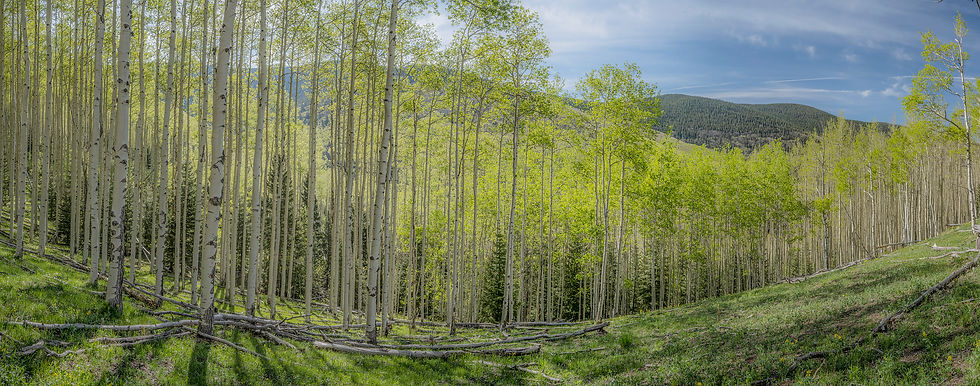
Photo by Irene Owsley
Photosynthesis: A Love Song
by Bette Korber
with:
Sunshine, Drizzle, Rain
by Peter Oviatt
Stories to accompany Photosynthesis: A Love Song
Personal stories: on the origins of the lyrics; my ties to an ancient melody; and creeks and trees, home and refuge
Science: on the origins of the matter that makes us, and how the inanimate is brought to life through photosynthesis
Science: on the age of everything, how photosynthesis fits into Earth’s cycles, and how global warming works

Personal stories: on fires too close to home and how climate change fueled the blaze
I. Path to a Song
Personal stories: on the origins of the lyrics; my ties to an ancient melody; and creeks and trees, home and refuge

A storm is on the way. In the west, summer winds often accompany the gathering clouds, and you can feel the sky changing while the rain is taking shape above. The wind smells so fresh before a storm, it stirs you up. Photo of my very sensitive hair barometer by James Theiler.

Thunderheads. Summer storm clouds gathering over Tesuque, you can see by the streaks of soft dark grey coming from the clouds that the rain had already begun in the Rio Grande valley below
Our wedding. [a] Millard Canyon, the band in the background, the creek behind them. Brian in his bishop’s robes, then James, and our friend Gina on the right. Long ago.


A Small Person with a Very Dry Dress.
“OK, we can go to the river today, but only if you promise you won’t get your clothes wet. It’s cold out!”
“OK, I promise.”

Cob beehive cactus
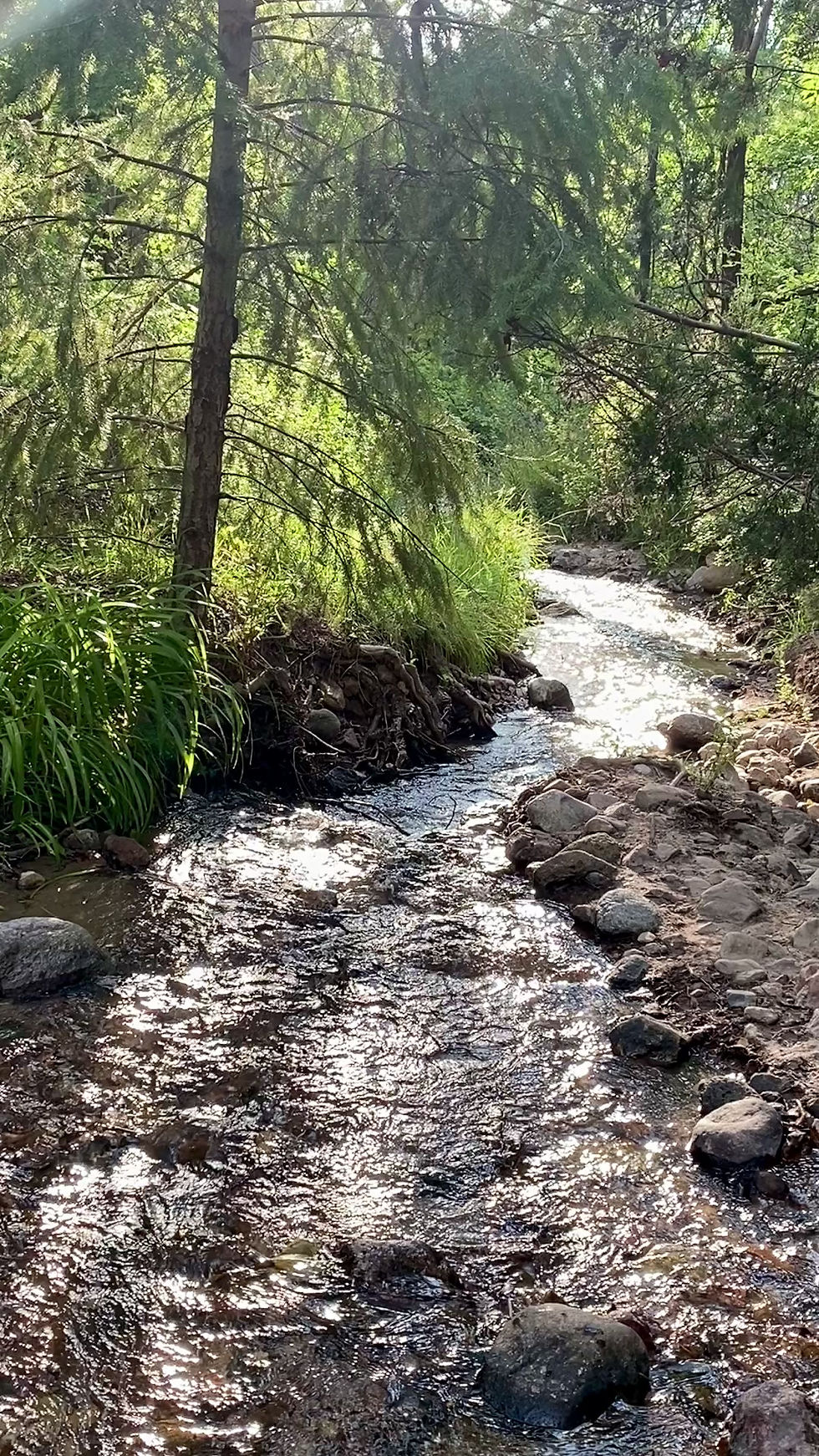
Tesuque Creek
The path to the lyrics. A trail starts by my home, and on it you can meander along a small creek that tumbles down through the rolls and flows of the hills at the base of the Sangre de Cristo Mountains. The creek follows a gentle canyon carved by the water’s own ancient meander, the water shaping the canyon, the canyon shaping the water’s course. Walking this path a thousand times has made it feel more like home than the walls of my house.
These mountains, the Sangres, mark the southernmost tail of the Rocky Mountains, where the hills finally melt into the high desert plains of New Mexico. Tesuque Creek spills out from forested peaks into the sunbaked world of pinon and juniper, flowering yuccas and the Apache plume that glow from within when backlit by a late afternoon sun. The surface of these hills is covered in mosaics of colored stones: gray, brick red, subtle green veined with white, chips of glittering pyrite, and fist-sized translucent bits of cloudy quartz. You step carefully there, as you’re in the cacti’s home: cholla and prickly pear, and the flamboyant little cob beehive cactus, Escobaria tuberculosa, a small but formidable bundle of spikes who gets dressed up wild and tempting to greet the bees of summer. It is the contrast to the dry hills with their hot sharp beauty and vast lonely vistas that makes the river path so alluring. You can follow the trail 20 miles up, deep into the mountains, sheltered by discoveries of cool shade offered by lush tall trees that thrive where the water flows.
Box elder, fir, cottonwood, spruce, pinon pine, and the rare aspen that found its way down from the high mountains into the canyon all flourish in the canyon. A few unexpected feral apple trees shade the trail. Their seeds must have slipped out of nearby orchards, perhaps carried in the belly of a bear, to make a break for freedom and find their own way in the wild. The tree roots all sample the sweet water that flows beneath the surface of the river, a trickling through the underworld. The water eases into and around the tender tree roots and complex webs of mycelium, threads of fungus that weave the roots of trees into an intricate tapestry of life-support beneath the surface. In the cool of the morning, the little summer river runs high, flushed and recharged by the watershed above. By late afternoon, the sun-warmed air of the sky above has inhaled so much water up through the trees luxuriating along the riverbank that the river becomes just a trickle of silver.
The trail serves as a passageway for ideas, inviting quiet conversations with my husband James, my friends, and myself when no one (at least no human) is listening. The playful cold waters of the creek have taught my favorite little wild things, my godchildren, all about the pleasures of leaf boats, of rearranging rocks in frisky water, of getting totally soaked when you are absolutely not supposed to do it.
The people of Tesuque Pueblo have lived downstream from my home since their ancestors first constructed the pueblo in 1200 AD. Tesuque is a Spanish attempt at the Tewa name for their pueblo, which means “Narrow Place of the Cottonwood Trees.” These people and this little river are deeply entwined, their long histories sharing the cottonwood’s shade and the sound of the sweet singing of cottonwood leaves in the wind. Some of these trees may have begun their skyward reach from seed-to-sun hundreds of years ago, as cottonwoods can live a very long time when rooted beside the comfort of a river. These trees carry their own stories alongside the stories that pass through the generations of Tesuque people. The place overflows with the unspoken.
This bit of wild is of course transformed by seasons. To me, it is most beguiling when the trees are in new leaf. First comes a moment in each year when the elegant bare branches of winter lose their sleek smooth sheen, turning to lines of knobby white lace against the sky as the leaf buds begin to swell and ripple along their length. Spring is on the verge of erupting. Next, warmth sails through the canyon. The great trees sense the change, feel the call to join in a chorus of creation that spills across the mountains. They begin to wake up and unfurl new and tender leaves. The overstory takes on a soft green shimmer of life, just a blush of green, with leaves so small that the shapes of the branches are still evident in their sky-seeking grace.
In those days of early spring, I tend to remember the tale of how the Earth spins light, air, and water into life. Trees, still and strong and stationary, are so nimble in their chemistry that their very breath creates the essence of life, later to be woven and rewoven on up the food chain. And so, thanks to the trees, we eat, we breathe, and then here we are, bits of earth and sky that rise up and walk amid the green, able to contemplate our intimate relationships with all things living. Sometimes I remember to whisper thank you. And one spring day a few years back, while walking along the path, I started to sample and sing the words that became the lyrics of this hymn to photosynthesis, a song of creation from light.
The path to the melody. This path is a windy one – the tune is centuries old and found its way into my ear decades ago. It follows the Irish tune Samhradh, Samhradh, which translates to Summertime, Summertime. I first heard it in 1978, in a live concert played by the Chieftains – the harp and whistle! Soon after, I took up playing Irish whistle just so I could learn to play Samhradh. I eventually learned that Samhradh also has lyrics, words shaded by green leaf, words strewn with yellow wildflowers, words scented by smoke and glowing with spark and ember. It is sung at Beltane, the Gaelic holiday marking the passage of spring into summer, as blossom covered trees are transitioning to leaf. It celebrates renewal. The ancient origins of this song are obscured by time, but people have been welcoming summer with it for many generations. If you'd like to hear this song of Beltane sung in Irish, try this haunting version: “The Gloaming: "Samhradh.”
Nearly forty years ago, the lilt of Samhradh lifted my husband James and I into our marriage. [a] Our wedding took place in Millard Canyon in the San Gabriel Mountains above Los Angeles; friends gathered with us on the banks of sparkling little Millard creek. As we walked up to a great white Sycamore to make our vows in the shade of her branches, a local Irish band played Samhradh. The Band included fiddle, Uilleann pipes, flute, and guitar, with bodhran, dancing water, and breeze-on-leaves playing percussion. Millard Canyon was just a mountain’s edge and a chasm past the urgent density of people that is Los Angeles, but it held at bay the smoggy haze and the roar of city. The Sycamore’s white limbs and green leaf formed an archway that opened to a wild place, a place that has offered refuge to the people of LA. [b] That was why James and I chose to have the Sycamore preside over our wedding along with our dear friend, Brian. Brian became ordained as a minister in the Church of Universal Life just for our marriage (we also bought him sainthood for an extra 20 bucks, as the Church offered a package deal). Turns out, the Church of Universal Life wouldn’t ordain a tree, and tree-sainthood was right out, or we would have had two saints to marry us. Our Sainted Brian found fine words to bind us as he stood beside the Sycamore’s trunk, with the river bearing witness, and our promises were spoken in English and translated into the language of dancing waters by the little creek.

Both Millard Canyon just north of Los Angeles, and Tesuque Canyon just north of Santa Fe, are ribbons of vibrant life cut by creeks through drier golden hills. Something in me has always been drawn to such places. I fear climate change is impacting them both. Last year, in January of 2025, Millard Canyon was caught in the Eaton Fire that took so much of Altadena and the northern boundary of Los Angeles. Nineteen lives (of the human variety) were lost to the flames of the Eaton Fire as they moved between the interface of the mountains and the city. After the fire, access to Millard Canyon was closed for a year, but it has finally reopened now in 2026. I’m eager to go back so I can check on my friend the Sycamore and play Samhradh on my whistle for him again. A perennial spring feeds the little river, and from the pictures happy hikers are posting, the creek is looking clear and lively.
Tesuque creek is fed by snow melt and summer monsoon rains. The word monsoon comes from the Arabic word for season, mausim. The rains come back to New Mexico each year because the summer season sun warms the land, while the seas stay relatively cooler. The air over the Gulf of Mexico is sea-laden with moisture. The shift in temperature from cool to warm draws the winds to us, moisture rich air from the sea blows in a wild caress over New Mexico, embraces our mountains, and then is lifted to cooler skies where the water condenses into the thunderheads. The clouds bring the afternoon rainstorms, providing for both the continuously flowing rivers and for the ephemeral streams which awaken in the rain, which in turn provide for the life in the forest, in the golden hills, in high desert wilds. The drought we are living in is changing Tesuque Creek’s ability to flow year-round. The winter snows used to be enough to keep the Tesuque flowing through the spring into summer, when the monsoon rains return. This spring the Tesuque river is low, some afternoons she is just a trickle, this after the lowest snowpack winter in the mountains in memory - the sweet little Tesuque may again go dry for a stretch before the winds bring the monsoons. She has gone dry a few times before in the 12 years we have lived here; prior to that it had been decades. When this happens the living beings in mountains suffer, as so many wild lives depend upon her waters. And of course, one also worries for the people, the farmers, who live downstream.
I came as a stranger to both the music and the canyons that I am writing about here and I am grateful to have found a bit of home in them. My known heritage is a muddle of immigrants, with little in the way of stories, melodies, or places passed down to link me to the generations that came before me. My grandparents found their way to Montana, my parents to Southern California, and my family to New Mexico. That is most of what I know of it. Even with such transient connections, I fiercely love each of these places, and all the people who populate my meager two generations of past. I wonder what it would be like to belong to a land with an ancient binding of ancestry, blood memory, and to feel the power in that, but that is not mine to know. Still, since I can remember, a sense of belonging has come to this stray soul of mine through the shape and power of the particular trees that have shaded the places I have called home. The trees, with their deep roots in the land, have somehow always made me welcome. I hope new immigrants in our communities are also invited home by the grace of green leaf, as We the People are doing such a poor job of being good neighbors when we are most needed by the newcomers to this land, those who come to us infused with hope and a will to work.
Path to a Song: footnotes and asides:
The footnotes here are stories behind the story above, please read them on a need-to-know basis (i.e., if you're curious). Friends who read “A path to a Song” had some shared questions about my own history, so I tucked my responses to their queries here.
a) An invitation to our wedding. James and I were grad students at Caltech, learning to become scientists, when we met and got married; please know that we are nerds and set your expectations accordingly. That said, here is a scatter of memories. Before the wedding, James and I hiked with friends up Millard canyon to the lovely waterfall. I wore my hiking shoes under my wedding dress, a black velvet skirt with a soft satin top embroidered with graceful leaves (of course) and I had flowers in my hair. James was in jeans, but he made the concession of wearing a long-sleeved shirt and a jacket. My dear Aunt Eileen, though she was in her 70s, managed the hike with us, lifting her skirts and boulder hopping over creek-crossings. When we got back from the hike, friends were gathering, and a fine Irish band was set up on the river and playing lively tunes. To surprise us, our mischievous friend Brian, who performed the wedding, came dressed in the finery of a bishop, but the bishop’s hat (a bishop’s miter) was too much even for our flamboyant Brian, so my dad wore the miter instead. It suited him. When the time was right, Samhradh rang sweet in the canyon; it gives me chills to remember it, and we marched forth on March 4th, 1988, along the cool of the creek to the shade of the sycamore. There Brian read some perfect words he wrote for us, and he made us promise to be good and true, and we recited more promises of our own device. We exchanged turquoise and silver rings – that is what we could afford, but also what we wanted, resembling small circles of sky and water.
After the wedding, the band and our friends came along with us to the Athenaeum (the “Ath”), the faculty club at Caltech, with its pillars and pomp, its graceful arches rimmed with bougainvillea, ornate ceilings, dark wood panels. Leaf-filtered light through tall windows was softened by twilight as the Earth spun away from the day and we sat down to dinner. Paintings of grand Nerds-of-the-Past (the “royalty” of Our People) glowered down from the walls, adding the necessary gravitas. After a slice of marzipan cake that was decorated with the words, “O frabjous day! Callooh! Callay!”, we kicked off our shoes, then danced like wild cats to the band, jigs and reels in big circles with our friends and family, inventing steps as we were called to by the music. Irish music summons dance, so everybody joined in the happy chaos.
We spent our wedding night in Einstein’s old rooms at the Ath, rooms that had been set aside for him to stay in when he visited Caltech in the 1930s. The Ath kept the furnishings as they had been for him, with a soft old leather couch, comfy chairs, a cozy bed, and a simple desk. Albert E. could have looked up to his right from that desk and out the second story window, to find his inspiration among the winding branches and green leaf of beautiful trees; these same trees had become grand and old and dignified by the time James and I were at Caltech. Stepping through the door into Einstein’s rooms felt like time travel. I think he would have enjoyed our wedding party; sometimes I like to imagine he did (in spirit).
b) Why a fledgling scientist needed refuge. Graduate school is a hard road for many people, but back in the day it was particularly hard for women. Caltech had first opened its doors to female students in 1970, and when I got there in 1981, there were still only a handful of young women who had pushed through that crack in the door to enter a Ph.D. program in chemistry. Of those who did, many pushed their way right back out to choose a better way to spend their twenties. So, my fellow grad students were mostly male. The worst of them enjoyed making openly clear to me they felt women shouldn’t be there. And working for my first advisor was grim. He was ambitious and dishonest. When work felt unbearable, Millard Canyon was a refuge where I could walk into the quiet beauty and exchange anger for resolve. The grace of the place reminded me that I wasn’t a prisoner in my own life; oddly, the knowledge that I did not have to stay enabled me to choose to stay. I wanted to be a scientist, to me science was a calling, so I was very grateful to the Sycamore that guarded the trail.
While in graduate school, I studied molecular biology, though I had an undergraduate chemistry degree and I had gone to Caltech intending to study the chemistry of solar energy capture (I had wanted to work on renewable energy because I was concerned about global warming). The crochety old man heading the chemistry department at that time felt that women were better suited for biology than the “hard sciences.” I wasn’t strong enough to stand up to him so I became a biologist. That lost battle is still my most bitter personal regret. So I spent my days as an experimentalist; most were spent running gels, unpleasant radioactive things that could be used to define the sequence of a stretch of DNA or reveal where proteins left their “footprints” when they bound to DNA while turning genes off and on. Other days were spent minding Drosophila mutants, red-eyed fruit flies cultivated for what their broken genes could reveal. (I would tell people I studied Developmental Biology, but my sister Dorothy would clarify, “Bette studies why maggots spit.” Both were true, but she was actually closer to the heart of things. Maggots spit to glue themselves to a surface to go into lockdown while their bodies metamorphose into flies, and we were trying to define the molecular triggers of those events.) Still other very long days were spent dissecting maggots in giant refrigerated “cold rooms”, pulling out their salivary glands using powerful microscopes, purifying their salivary proteins and isolating their RNA. Many nights I dreamed of maggots. I did not love this world. Many of my peers, however, did love this work - they were trying directly solving questions about life at a molecular level at a time when a revolution in knowledge was occurring. Understanding Drosophila was one well-traveled path to discovery, it was just not a good path for me.
During those years, I took a class taught by Dr. Ellen Rothenberg, a rare teacher with the gift being able to share with clarity the current state of knowledge in a complex field and her exuberant love of the subject. Things had gotten very difficult in the first lab I was in, but her class opened a new path for me, as I felt excited by the ideas I was learning and felt like I could push to change fields. So, after 3 years of grad school, I discovered a way to escape the fruit flies, though at high cost - giving up all the work that had gone before and leaving it unfinished. Throwing away 3 years of hard work was not easy, and I was a mess. A few senior scientists who had witnessed what was happening in the first lab I was in made sure I had the option to start my thesis over in a new lab. Two people, Stewart Scherer and Roger Perlmutter, advocated for me, and helped me find a much better possibility in an immunology lab, under the wing of a new mentor, Leroy (Lee) Hood. At that crossroad I had two options: starting my thesis over again with Lee or quitting and moving to Montana and trying to find a job. My father felt such a big decision called for big canyons. He drove me to Utah, and we spent some days in Bryce and Zion. His arthritis was too painful for long walks together, so he brought good books to read and sat on shady park benches and set me loose to walk and think. On that trip my father listened to me sort through everything with love and no judgement. Four years later I finished my PhD with Lee. But even with the change to immunology and to a good advisor, days at the lab bench were long, and I missed the sun on green leaf. The geology students would come in with dust on their boots from field work, the physicists could be found arguing ideas at white boards, and I was jealous of both.
In those days, I also had another need for the Sycamore’s refuge. By the time of our wedding, our sainted friend Brian, the man who had married James and me by the Sycamore, was beginning the slow process of dying of AIDS. At that time there was no treatment. Brian had been my housemate for 5 years; I loved him like a brother. After we graduated from Caltech, Brian and I stayed close. So, after grad school, I went to Harvard to study HIV and viral evolution and immunology. From that perch I could keep a watch on the literature and advances in the field to see if any new discovery could help Brian (as well as the 10,000,000 other people then living with HIV). No effective treatments were in time for Brian. AIDS was discovered in 1981. In 1986 we learned Brian was HIV-1 positive, as he had early signs of AIDS. In 1992, Brian died with severe HIV-associated dementia. The first useful therapy for AIDS wasn’t discovered until 1996. Those were long years. Brian’s suffering and knowing that variations of his pain were being realized in all the people living with AIDS and that my own fear for Brian and my sorrow was manifest in all the families and friends that loved them gave me motivation for my work.
I finally ended up at Los Alamos National Laboratory, where I was welcomed into one of the first theoretical biology departments in the world, founded by physicists who were intrigued by what could be learned mathematically from all the new biological data that was streaming into the scientific literature. Los Alamos National Laboratory was originally created to build the first atomic bombs that were used in World War II; the Lab has indeed always focused on defense and nuclear weapons. But it had expanded over decades to include other diverse scientific efforts to serve the nation. These included infectious disease work (a place for me), astronomy, satellite imagery (a place for my James), and climate research. I could put my hard won biological knowledge to good use at Los Alamos and have my day-to-day work be thinking about viral evolution in a mathematical and computational framework instead of at the lab bench. I liked my colleagues. I liked the work. I liked service. And I loved the setting. J. Robert Oppenheimer, who led the effort to build the first nuclear weapons, had tucked the Laboratory into the high mountains of New Mexico, a place chosen for both isolation and beauty. Mesa tops, mountains, and canyons framed a place where I could step into my life and breathe. I finally outran the damn gels and had come home to the mountains, to a life of arguments at white boards, and to dust on my boots.
II. Light Sparks Life
Science: on the origins of the matter that makes us, and how the inanimate is brought to life through photosynthesis
"To this goal of understanding, all men—scientists and laymen alike—bring the humilities which accompany recognition of beautiful and complex events. Each brings also the gift of his own experiences, which alone will allow insight into a profound phenomenon."
— Melvin Calvin, 1969
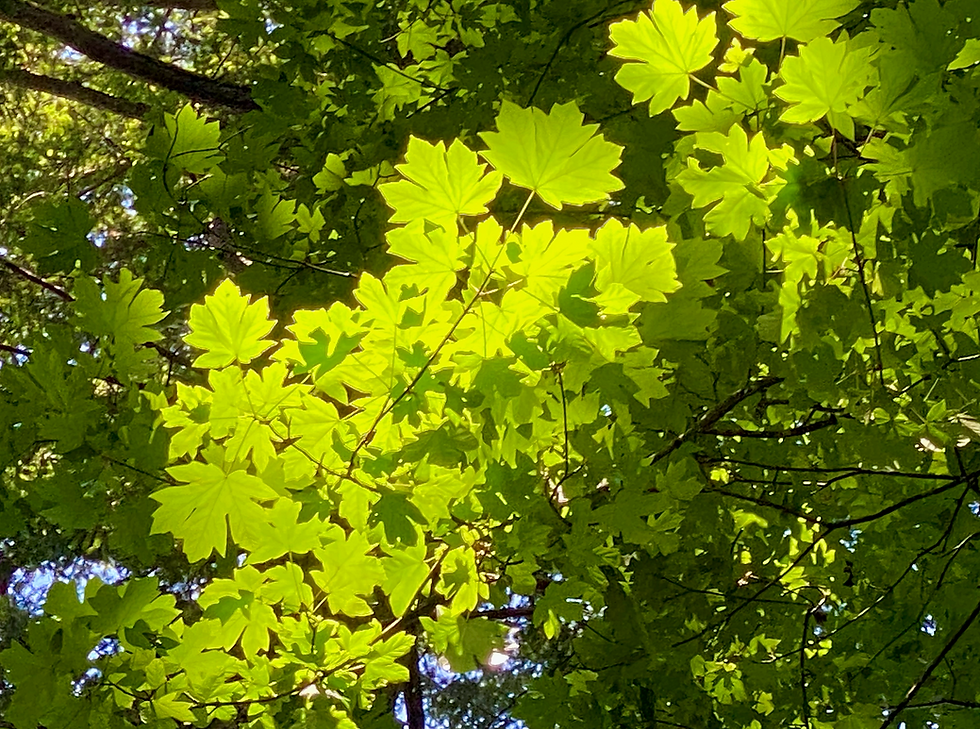
Maple leaves, Snoqualmie Valley Trail
When you next step out-of-doors into the morning sun, consider for a moment that each leaf and blade of grass you see is incredibly busy catching sunlight to construct the basic chemical framework of life. As the leaves do this, they also create oxygen, the breath of life in the animal kingdom. Photosynthesis occurs in the microworld of spinning molecules [a], but its consequences spill into the macroworld of the carbon cycles on a planetary scale. Through it we are all bound intimately into interwoven systems with the Earth and the Sky. The leaf is a life-weaver, and with that understanding I fell in love. Tree hugger? Yes, you’ve caught me. I remember the raw joy in the simple epiphany the first time I really understood that photosynthesis, by harvesting the sun’s energy, transforms lifeless little bits of matter to build the foundation of all living things. I’ve tucked that sweet realization into my back pocket as a remedy to the mundane. When I slow down enough to remember it, it never fails me – it stirs a jumble of gratitude, awe, and delight.
The word photosynthesis combines Greek words for “light” (phōs) and “putting together” (synthesis), to mean "putting together with light.” Photosynthesis manifests in different ways, but the chlorophyll-driven path in the figure below is the major path to the essence of life in our world. Homo sapiens (that would be us) came onto the scene about 300,000 years ago, born into beauty that is evident whenever we take a moment to look around, enabled by this first reaction of photosynthesis. You don’t need to understand the chemical details to enjoy the science, although it is a tribute to human ingenuity that the chemistry has been worked out precisely. In case you want to learn it anew or be reminded afresh of the bare bones of it, I made you the little figure below. Just the recipe on the top line of the image is enough: Mix Air + Water + Sunshine in a leaf, season to taste with a bit of mystery, and out comes Life.

What comes into and out of photosynthesis. Grasses and leaves on land, and algae like phytoplankton (the foundation of life in the ocean), use sunlight’s energy to combine water (H2O) and carbon dioxide (CO2) into life by channeling electrons, remixing oxygen, carbon, hydrogen, and re-framing them as glucose and oxygen, which are both charged with the sun’s energy. Glucose is energy and matter primed to enter the metabolic pathways of Life on this Earth. We all build from this foundation the vast array of complex molecules needed by our cells, our organs, our bodies to become a living being. By the way, that’s me and my son Max in the picture, two small beneficiaries of this perfect Earth chemistry.
H, C, and O
Sunlight and combinations of these three atoms, hydrogen (H), carbon (C), and oxygen (O) make up the in-and-out of photosynthesis. Hydrogen is the smallest, simplest atom, but a major part of everything that is. The nuclei of hydrogen atoms have kept their integrity of form since near the beginning of time. 62% of the atoms in our bodies are hydrogen, so within you, you hold tiny sojourners that have traversed the history of the universe; parts of what is us witnessed when the cooling after the Big Bang first allowed hydrogen to take shape. The bigger atoms, carbon and oxygen, came along later, fused into being from hydrogen and helium in the stellar furnace of red giant stars. The carbon and oxygen in us were made in red giants that long ago spun their tailings into space and finally exploded into stardust that was reshaped into our solar system, and our own Earth. So, we are directly linked to red giants, in a way they formed a part of our deepest ancestry

Stoma. Image by Annie Cavanagh, Welcome Images cc 2.0
The stellar origins of carbon (C), oxygen (O) and water (H2O), bright spots in the night where you can witness the universe building the basic ingredients that equipped the Earth for photosynthesis. If you look out into a starry sky, you can readily see some red giant stars shining; they are building carbon and oxygen as they burn. Two are particularly easy to spot. Betelgeuse is the red spark that is Orion’s shoulder. Orion strides across the evening sky in late Winter in the global north, with Spring on his heels. The brilliant Arcturus is out later, towards Summer, and is among the brightest stars in our night sky, and the brightest star in the constellation Boötes, hence its nickname is Alpha Boo. You can spot it by following the arc of the handle in the Big Dipper (in Ursa Major, the Great Bear) and then you “arc to Arcturus” – let your eye follow the curve out until it lands on a very bright reddish star. In ancient stories Alpha Boo guards the great bear. Perhaps the essence of life to come, in an epoch in the universe deep into the future, is brewing inside their reddish glows, as when these stars are gone, new planets may spin out of the carbon and oxygen in their dust. While we are visiting Orion, I’ll share one more lovely thing to know. In a very fine dark sky, you can make out the three stars of Orion’s sword and notice that the middle one has a softness to its light. It is not actually a star, but the Orion Nebula, a star nursery, where new planetary systems are being born within a vast cloud of dust that swirls through interstellar space, as gravity pulls the denser bits together to shape new stars and their planets. The Orion Nebula also is called M42, part of a list of 110 Messier objects, all with their own M-number that are soft patches of light, nebulous bodies and galaxies. Just there, in Orion’s Nebula, enough water is being created each day to fill the Earth’s oceans 60 times over. Our Universe is good at making water, and liquid water is likely found both on and in many planets, lending credence to the tantalizing thought that we are not alone in the Universe. This little star map was created by James Theiler, Bette Korber, using AI implemented with Claude.
A deeper look at photosynthesis shows it includes two cycles linked by energy carriers that swirl between the two cycles. First are the light reactions, fed by water and sunlight. Water is taken up by plants through the earth by their roots and brought up into their leaves where it evaporates into the air, pulled up through microscopic pores, called stomata, on the leaves’ surface. Plants breathe through these stomata, with sometimes hundreds of thousands on a single leaf; they take in CO2, and H2O and O2 are exchanged. Trees open and close these pores in response to weather, to fire, and to light and dark, as they control the flow of water through their giant bodies, balancing water conservation in the heat of the day (or during drought) with water movement through the leaf in daylight to enable photosynthesis. Trees are living water channels to the sky, a vital part of the great cycle that moves water from earth to cloud. The water then cycles back to Earth through rain, fog and snow, back into the thirsty soil to be sought out and sipped by a tender root and once again carried skyward.

Stoma. Image by Annie Cavanagh, Welcome Images cc 2.0
As water flows from root to sky some of it is captured by the leaves for use in light reactions. The leaf deftly uses this water and the energy in sunlight to charge up two molecules (called ADP and NADP+) to become energy carriers and electron porters (called ATP and NADPH). In charging them up, water is transformed and the oxygen water carries is released - and so, thank you, leaf, we breathe.
The energy carriers from the light reactions deliver energy and electrons into the path of the dark reactions of photosynthesis (called dark as they don’t depend on sunlight). The dark reactions are also known as the Calvin cycle, named for Melvin Calvin, the man who, together with Andrew Benson, sorted out this chemistry. He described his work as, “following the trail of light.” He later said he was referring to light as understanding, not sunlight, (but, oh Melvin, you must have enjoyed the double meaning). The dark reactions take CO2 from the air and more water to weave glucose (sugar), the energy-rich organic molecule at the center of life.
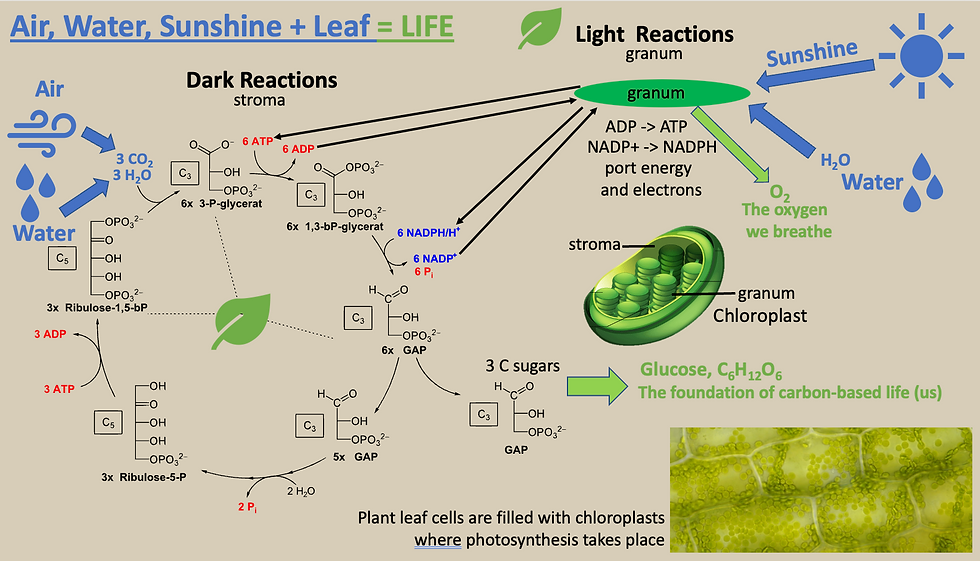
The light and dark cycles of photosynthesis. As in the simpler summary in the earlier figure, what comes into photosynthesis is in blue, what comes out is in green. In the light reactions, water and light come into the leaf, water is split, O2 is given off, and the energy of the sunlight and hydrogen is transferred to energy carriers which port it into the dark reactions. In the dark reactions, CO2 and H2O are spun onto the backbones of molecules that carry their atoms, C, H, and O through a series of steps that will enable the formation of sugars. The air, water and light come in, the sugar and oxygen come out; everything else stays in balance after a series of cyclical transformations. If you would like to learn more about the details, which are shown only roughly here to give a sense of the complexity of the two cycles and how they interact, I found the Kahn Academy’s Intro to Photosynthesis to be a very helpful guide.
The comfortable chemistry of the atmosphere that cloaks our Earth is both shaped by the life that is everywhere on the surface of the planet [b], and in return has shaped the life that prospers now. What I mean by “comfortable chemistry” is comfortable for us, the living things that have evolved to be at home in it. The life, the skies, the seas, and the lands co-exist in balance. We take in oxygen when we breathe, and every leaf opens to the airy mix that carries the CO2 it needs to survive and to fuel creation. As glucose is assembled, the energy porters ATP and NADPH revert to ADP and NADP+, and circle back into the light reactions to be recharged once more by the sun.
The two cycles are prayer wheels spun by the touch of the sun.
Our atomic composition is of course not as simple as the C, O, and H of glucose. The molecules we living beings assemble in our bodies also hold nitrogen, phosphorus, calcium, and other essential traces of stardust. If you look closely at the figure showing the light and dark cycles, you’ll see P for phosphorus, an essential part of the molecular backbones that move through the cycles, but there is no net gain or loss of P as these cycles spin. The transition of the inanimate towards life begins on the simple carbon backbone of glucose that emerges from photosynthesis and goes on from there. First, a plant taps into light, water and air to build itself. The herbivore eats the leaf, the carnivore eats the herbivore, and we omnivores eat everything we can. And we are also powered by every breath that brings us the oxygen that was also created in the leaf – as you read this now, breathe deep: Blood-born oxygen courses through you, your thoughts fire up, and your heart beats another beat.
All this born in a sun-kissed leaf.
Footnotes and Asides:
a) Help in my own understanding of photosynthesis. With thanks to Professor Govindjee for carefully reading an earlier draft of this essay and ki. ndly offering some helpful editing suggestions. He sent me a remarkable reading list; you can find links to his writing on his web page. He pointed out that CO2, was also brought into and out of the more complex chemistry of the light cycle, as well as feeding the dark cycle.
Also, with gratitude to Professor Hartmut Lichtenthaler, a botanist who founded a research institute at the University of Karlsruhe where the science of photosynthesis was advanced. He sent along these very kind words that made my heart sing:
"Thanks for your song and music on nature, plants, on Photosynthesis and Melvin Calvin. ... I worked two years in Melvin Calvin’s
Laboratory in Berkeley from 1962 to 1964. He was a great scientist and wonderful person. He would have liked to hear your music
and to see the photos and his photo being included. As I knew him very well, I am very sure of that."
-- Hartmut Lichtenthaler, 2022-09-16
b) Life is everywhere you look. You can’t miss ubiquitous life anywhere on the surface of our dear Earth. Every seemingly unlikely pocket holds it: deep in the heat beneath her surface, windblown through the clouds that grace her skies; multiplying in the darkest crevices of her deepest seas; gliding through the frigid cold of the Arctic polar ice cap; and carving a home in the sand of her hottest sun-seared deserts. Everywhere you look, living things living. In contrast, on Mars where we have looked and looked and looked (from a distance), still we have found no definitive trace of life, only an isolated hint.
III. How the Planet Breathes
Science: On the age of everything, how photosynthesis fits into Earth’s cycles, and how global warming works

NASA astronaut, Artemis II mission specialist, and Earth daughter Christina Koch looks at Earth from the window of the Orion spacecraft on its way to the Moon. Image credit: NASA, April 2026.
Once upon the way-back, about 4.5 billion years ago, a cloud of spinning dust scattered from exploding stars began collapsing into our sun and solar system. In this swirling mix, our Mother Earth began to take form. She was shaping into a water planet. Just how Earth came to be so drenched in water (71% of our blue planet’s surface) and so, so open to life is not precisely worked out. Earth appears to be in good company, as astronomers are finding increasing evidence that water is abundant in the universe and many planets are water-rich, though often the liquid water may be under the surface. Still, evidence for liquid water on or in so many planets (and in moons circling planets in our own solar system) raises the possibility of life stirring there. Earth likely made much of her own water, but asteroids have also brought water to her, in the form of ice frozen into rock and carried through the lonely cold of space. In any case, she took what she had been given, and in the warmth of the sun, she has harbored life for most of her long history – and she is a very old lady indeed, given that the Universe is ~13.77 billion years old, she has been around for roughly one third of existence. [a] The earliest life on Earth likely started 3.8 billion years ago, with a chemistry of energy flow called anaerobic; this means it did not yield the oxygen we need to breathe and live. The Earth’s daily spin brought the sunlight shining down onto all her great seas. Bathed in that light, around 2.9 billion years ago, a type of bacteria called cyanobacteria evolved that could use sunlight to split water and charge its life force through oxygen-producing photosynthesis. Each cycle of photosynthesis spilled oxygen into the waters, which eventually began to diffuse, to move from the sea and into the sky. The collective breath of oxygen from cyanobacteria ultimately changed the chemistry of our planet in something called “The Great Oxidation Event.” The pace of this change occurred over hundreds of millions of years, and other microbes started evolving to use the oxygen created by the cyanobacteria in the seas. The world changed to harbor new forms of life centered on aerobic photosynthesis, and the reactions that create breathable oxygen rippled through the life force of the planet. Earth and its early life began to evolve, to eventually find the relative balance and flow of life, water, carbon, and light that we currently occupy. With or without us, eventually this balance will pass into something new. What we are doing now with global warming is accelerating that change and pushing with great haste towards a world where life as we know it will not prosper.
Our Mother Earth is a closed system - very little new matter reaches us from space, and very little leaves our world. This means Earth holds a fixed total amount of carbon, the element central to life; it is linked chains of carbon that frame the molecules that in turn shape us. Carbon continuously cycles through our planet, moving through the atmosphere, through living things, through the seas, through sediments and soil. How much carbon in the atmosphere determines how much of sunlight’s warmth the earth retains. Carbon keeps different tempos as it cycles. The slow cycle is framed by geological events that can span hundreds of millions of years. Earth’s slow flows of land across its surface impact these slow carbon cycles; massive tectonic plates of rock are ever moving along the Earth’s mantle, bumping and shifting, sometimes shaking us up with a tremor or quake. [b] These movements can drive volcanic eruptions, pushing carbon from deep inside the Earth’s mantle into the atmosphere, a natural part of the slow cycle. For perspective on the extent of our capacity to drive climate change, all volcanoes combined, across the planet, release 100-fold less carbon than do human activities. Mount St. Helens massive 1980 eruption vented 10 million tons of CO2 from the Earth’s interior into the atmosphere in its first 9 hours. This much CO2 is generated globally by humanity every 2.5 hours. Mount St. Helens backed off once she had vented; in contrast, we are relentless. Thus, the carbon impact of volcanoes is small compared to the devilry we are up to. Another example of carbon’s slow cycle is when fifty million years ago the lands we know as India and Eurasia collided, and the great range of the Himalayas rose up along the boundary of their collision, called an uplift. The newly exposed mountains of rock face caused a shift in the slow carbon cycle, as the mountains slowly weather under the millions of rainstorms, and drop-by-drop these rains shuttle carbon from the air through the rock surface, and into the waters. As the jagged Himalayan peaks were pushed skyward in the great uplift, there was a major shift from a warmer world to the colder world in which we and our furry and clever mammalian brethren have evolved. The extent of the contribution of weathering of the Himalayas to the shift to cooler global temperatures continues to be evaluated, but the creation of mountains as shifts in tectonic plates drive both uplifts and volcanoes are essential aspects of the geological push and pull on carbon.
The climate patterns, the temperatures and behavior of the seasons, depend on the amount of CO2 in the atmosphere over seasons and years as carbon moves through fast cycles. NASA has made movies like the one enclosed below that model the movement and concentration in the atmosphere over the course of the year of both CO2 and carbon monoxide (CO), which is released by fires. The green growth of spring and summer spinning through its life-giving photosynthesis reins in the excess CO2 that we are spilling into the world. The trees are acting as guardians. But in the autumn and winter when plant growth is slowed, the CO2 ripples wild across the planet. The great fires of the late summer and autumn load the sky with CO (carbon monoxide), much from the burning of forests for agricultural clearing, which blows across the planet as fall progresses. CO is a pollutant that is not directly a greenhouse gas, but it can stabilize other greenhouse gases in the atmosphere, like methane, and so contributes to global warming in that way. These fires also reduce the long-term ability of forests to maintain Earth’s resiliency as we continue to burn fossil fuels, by diminishing the forests’ capacity to bring in CO2 through photosynthesis. 2025 was the second worst year on record for global wildfire activity.
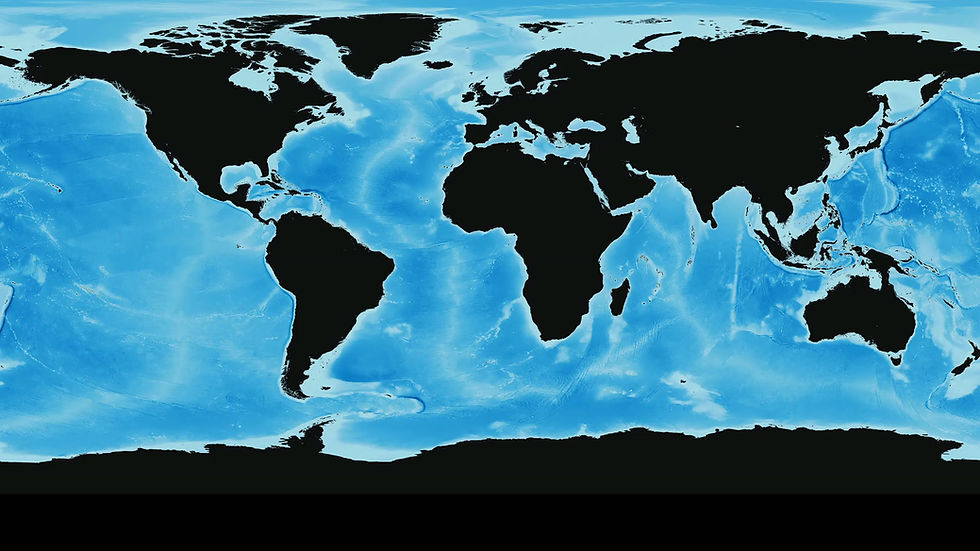
A high-definition view of how carbon dioxide in the air moves around the world with the winds through much of a year. This video is from NASA’s Goddard Space Flight Center and its release date was Nov. 20, 2023. The deeper the red represents more CO2. The video starts in summer, when the plants are in full leaf, and they are taking up much of our excess CO2, and as autumn and winter settle in and plants lose their leaves, the carbon soars, the deeper the red, into purple are the highest CO2 concentrations. During late summer, forest fires in South America and Africa produce plumes of CO that are shown in grey, later you see them in Australia. This link takes you to an older version video that has very informative text.
The essential problem is captured in the graphic of the fast carbon cycle included below; it is the excess carbon. The carbon rich remains of ancient life on the planet, lives that were lived millions of years ago as algae, plankton and plant, are tucked away as organic carbon that was set aside from the carbon cycles. It was pressed over time by the weight of the land and sea into the earth’s bedrock, where it transformed into the hydrocarbons we extract as fossil fuels: coal, oil, and natural gas. For eons, this dark source of energy stayed tucked away, deep in the earth. With our fracking, our wells, and our coal mines we are moving carbon up from where it once was held safely, burning it and breaking it down for its energy, and releasing the carbon it held into the air. Those carbon stores that took millions of years to build up, we are releasing in a matter of decades, in a breath of fire. This puts vast amounts of excess carbon in the air. As the atmosphere has been overloaded with our carbon waste, the plants and the sea tempering our folly, taking up even more carbon than they would otherwise, and this helps slow global warming. But they cannot keep up with us, and so year by year we are creating an “Atmospheric Carbon Net Annual Increase.”
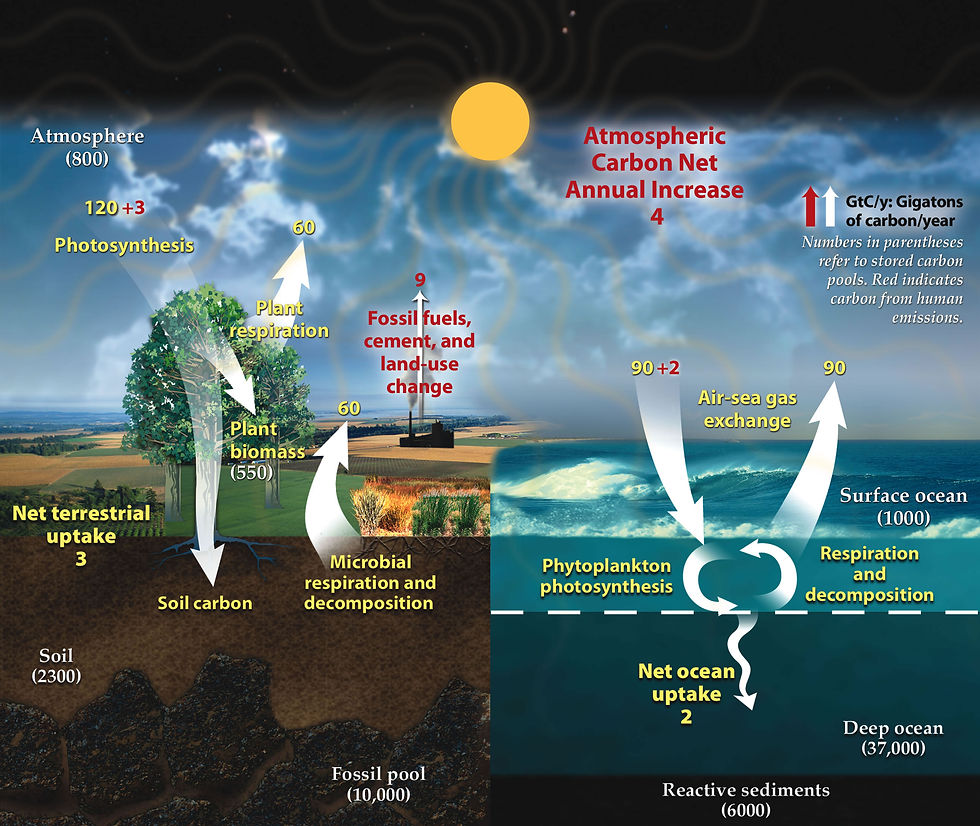
The fast carbon cycle. The movement of carbon between land, atmosphere, and oceans. Yellow numbers are natural fluxes, and red are human contributions, in gigatons (a gigaton is a billion metric tons) of carbon per year. Most carbon on Earth is stored in rocks and sediments; white numbers indicate stored carbon, held separate from the sky other than through change in the slow cycles. (Note: I found this figure Wikipedia; I’ve read it was originally adapted from a U.S. DOE graphic; it is widely used on educational site; I suspect the numbers may need to be updated, but they get the point across – Bette)
The Amazon rainforest pulses with the rhythm of these cycles, vivid with life’s abundance even when viewed from space. Its trees spill glorious and green over 2.5 million square miles of Earth, with lush and complex vertical layers of branch and leaf canopy drawing carbon from the sky, breathing oxygen out into the surrounding world (the plants and other life in the forest breathe oxygen in, so the forest does not generate excess oxygen) and fueling the astonishing complexity of all life that prospers in their shade. The trees build their great cathedral forests, year by year, ring by heartwood ring, shaping themselves into great living water channels to the sky as they reach for the sun, carrying the water up from the river-winding world of the rainforest back into the sky. The great rainforests are often thought of as lungs of the Earth [c], though while they take in CO2 and give off O2, the life in the rainforests breathe in as much O2 as they produce, and are in a balance. The Amazonian rivers and their waters can likewise be considered her dancing heart, life-giving flow and movement of water, with the great trees circulating the water from earth to sky.

Sunset glint on the Amazon River, Brazil, August 19, 2008. Astronaut photograph from the international Space Station ISS017-E-13856. About 150 kilometers of the sinuous Amazon is shown here. NASA
The vast oceans can also be considered lungs of the earth -- everywhere is breath. The sea’s surface is a vast but intimate connection to the sky, and molecules shimmy and shiver between the two in an invisible equilibrium stirred by wind and tide and swirling eddies. The CO2 carried in the exchange between air and water feeds the photosynthetic pathways of phytoplankton teeming in the waters at the oceans’ surface. Just like on land, carbon is woven into ocean life first by photosynthesis (but in phytoplankton, rather than leaf), then is carried up through the food chain. When sea life dies, some carbon released through decay will be sequestered deep in oceans, sometimes naturally carried downward in eddies, or sometimes tumbling down in the waste of creatures like the translucent little salp. Salps are also known as sea squirts, a name that evokes how they propel themselves through the water: squeeze and whoosh. They come together to graze in great salp blooms to feed on phytoplankton. The salp is a living carbon pump. They eat the phytoplankton as they squirt around the surface, digest the organic carbon that the phytoplankton generated via photosynthesis, and then carry the waste down into the deep, dropping 600 meters in their dives, leaving their dense carbon rich waste behind. Gravity pulls their poop ever farther down, into Davy Jones’s deepest abyss, where it lingers safely stored away from the atmospheric carbon cycles. Better understanding of the ocean’s natural climate guardians, like water’s eddies and living salps, may someday suggest relatively benign strategies to hold some of the excess carbon we’re furiously burning on the land deep within the sea.
The great carbon cycles are not just playing out in dramatic scales in the seas and rainforests. These cycles are ubiquitous. Everywhere we look, the water, carbon, and oxygen cycles embrace us, move through us, and shape the landscapes through which we walk. Before there were so many of us (2:55 PM, April 21, 2026, we were 8,288,522,667 and counting), before we figured out how to tap the buried energy locked in fossil fuels and bend it to our will, the flow of carbon in the world was in equipoise, a state of balance. Now, those who can afford the fuel are cozy and warm in winter, comfortable and cool in the summer. We push back the darkness of night in our homes and cities filled with light. We move with dizzying speed in our cars, trains, and airplanes. We build megacities and reshape landscapes. As we do this, we are burning coal and gas and oil far too fast, pouring millions of years of life’s history into the sky essentially all at once. In harvesting this energy and releasing the carbon of life’s ancestry, humanity is pulling the earth, sea and sky out of balance.
I was born in 1958. Over my lifetime, a quiver in history far less than even the blink of a geologic eye, we have pushed carbon levels in the atmosphere to much higher levels than had been seen in the 800,000 years before (see the graphs below). We can know this 800,000 year history because ancient ice from glaciers and ice sheets holds these stories of the earth and sky. Scientists sample the ice in long cylindrical cores that are temporarily stored in freezers for later analysis. The deeper the sample, the older the ice; and like tree rings, there are light and dark bands making the ice year by year, as well as annual changes in water chemistry, and so you can count off the years simply by counting down the column of ice. Tiny pockets of air locked in the ancient glacial ice can serve as time capsules, and the chemistry of the air trapped in these bubbles can be tested to determine what the carbon content was like the day the ice formed, enabling a reconstruction of the history of the atmosphere. And so, we know we are entering uncharted territory: in the last 800,000 years the sky has never harbored CO2 levels like we are creating now. Through our collective science, however, we understand our planet home well enough to anticipate the dangerous consequences of so much carbon in the atmosphere, and just as the scientific community predicted, the Troubles are now manifesting. As violent storms. As lethal heat waves. As catastrophic megafires that leave scorched earth behind. As droughts and dwindling rivers. As dying seas, both too warm and too acidic. As seas rising to swallow shorelines. And in the lives of millions of climate refugees who have already lost their homes and livelihoods to these disasters. Embedded in the terror of these global events are the tragedies that many of us have personally experienced, and the sorrow we carry for what we witness when we open our hearts to others.


The rise of carbon dioxide. Top: CO2 levels over the last 800,000 years are shown in this NASA graphic. The arrow “current level” was from about 10 years ago when the graph was made. For 800,000 years CO2 levels rose and fell, and then suddenly, look at how the line goes vertical on the far right! The vertical rise is our doing. CO2 levels are much higher than they have been in 800,000 years; we are taking the Earth into a dangerous new epoch. Bottom: The Keeling curve showing the last 70 years of atmospheric CO2 levels in a graphic from NOAA, the National Oceanic and Atmospheric Administration. This graph shows the monthly mean carbon dioxide measured at Mauna Loa Observatory, Hawaii. This provides the longest record of direct measurements of CO2 in the atmosphere. This plot is a gift to the world from the rare scientific mind of Charles David Keeling. By the time David (he went by his middle name) started to take these measurements in 1958 and to plot the “Keeling curve,” we were already above all the peaks of CO2 due to natural fluctuations in the last 800,000 years of the Earth’s history. The red lines show monthly mean CO2 levels, the black lines the same, but corrected for seasonal cycles. The Keeling curve plot spreads out the near straight vertical line in the 800,000-year NASA plot but uses experimentally sampled real time data over the last 70 years. The upward sweep is relentless.
We are warming our planet because changing the amount of greenhouse gases in the air changes the way the earth holds onto the sun's heat. Very simply, we are putting more heat-trapping gases in the atmosphere, and so they are trapping more heat. Greenhouse gases warm the earth by catching the sun’s warmth as it is outbound after reflecting off the surface. The sun’s energy arrives as short wavelength light that shines past the C02 and water in the atmosphere, warming the solid earth. The earth re-radiates this sun-given warmth back out towards space, but as longer wavelength light, which CO2 and other greenhouse gases like methane can absorb it as it passes on its way out from our planet. The outbound warmth that is caught in these gases is re-released, scattered in all directions, and some of it heads back in towards the earth. This is natural, and it gives us the global climate we are familiar with, the planet we understand and have evolved to thrive in. But greenhouse gases released from burning (and burning and burning) the extracted coal and gas that was once safely stored in the Earth are increasing in the atmosphere to such an extent that we are beginning to feel the excess heat they sling back to the earth. In the scientific community, there is no question we are warming, you can see it in rigorous scientific measures like the plots below. But you can also know it’s true from your own experience across the seasons. For example, where I live in the western Rockies, we are in a record snow drought in 2026. Year by year, winter seems to be leaving us.

Global temperatures show that the last 11 years have been the hottest in recorded history. The global and hemispheric temperature anomalies are shown as differences with respect to the 1901-2000 average. The data is from the NOAA National Centers for Environmental information, Climate at a Glance: Global Time Series, retrieved on April 18, 2026. Land and sea are separated to emphasize how hot it is getting on the land.
Using strategies like those developed to forecast weather, scientists can hindcast weather, to look back across deep time and begin to reconstruct the climate history of Mother Earth over 485 million years of her history. In this long view, big changes in temperature correlated with changes in CO2. We are born into a time of relative cold, but this ancient pattern of cold is ours, it shaped the seasons where we thrive, the world where our ancestors stepped through the evolutionary passages that brought us into being. We are driving the world back towards a heat that hasn’t been experienced for a very long time, and this warming is occurring at an unprecedented pace. We know that when temperatures have changed “abruptly” across our planet, mass extinctions have accompanied the change. When a large asteroid hits, catastrophic change can ripple across the Earth in a flash, flames and shock waves engulfing the planet, with layers of dust and smoke left behind that change the planetary climate for the decades following. This happened with the Chicxulub Event that took place 65 million years ago, when an asteroid struck Mexico and suddenly ended the age of dinosaurs; it is thought to have taken out 70% of the species on Earth. But, given that our dear old mother is 4.5 billion years old, “abrupt” in Earth-time can also sometimes span a few million years. In terms of change to Earth’s carbon cycles from within, humankind has now brought a whole new level of extreme to the notion of abrupt: just 70 years. The last 11 years are the hottest on record, and the Earth is out of balance. Meanwhile those who profit from fossil fuel extraction have developed disinformation strategies to distort and deny the good science that could have guided us into earlier action, slowing opportunities to respond to global warming, and they are still are able to shape the way many of us view reality. To have a good chance of keeping our life-laden planet spinning into a future we can recognize, we must limit global warming.
The nations of the world finally recognized this truth, and united in designing and ratifying the 2015 Paris Agreement, a legally binding international treaty on climate change. We agreed as one world upon a science-based target to try to limit global warming to no more than 1.5 degrees C above pre-industrial levels, a level that could shield the world from the direst impacts of climate change. Significant progress has been made, and much of the world is on track with economically viable solutions to enable a sustainable future such that, according to the UN, “by 2030, zero-carbon solutions could be competitive in sectors representing over 70% of global emissions.” Under Presidents Obama and Biden, the US was part of the Paris Agreement, and our country was doing our part. Biden’s most notable achievement during his presidency was the landmark $391 billion climate solutions investment bill — the Inflation Reduction Act (IRA), that was passed in 2022. By August 2024 the IRA had been in play for two years, and 334,000 jobs had been created with an economic value of $265 billion, and $27 billion in investments had been made in reducing harmful pollution by cutting emissions and in advancing clean energy technology. America was on track. But Biden could not articulate this clearly to the American people. This left too many of us not understanding the environmental wisdom and economic value of the transitions to clean energy his administration had implemented that were already well in play when we reached the voting booth in November.
The extraordinarily beautiful thing about the Paris Agreement is that nearly every nation in the world signed on to it, 194 countries and the EU. The extraordinarily shameful thing, if you are an American, is that President Trump has twice withdrawn our nation from our legally binding commitment to the Paris Agreement, each time he got elected (2016 and 2024). Meanwhile, the Earth is hovering unnervingly close to the 1.5 limit already. To even have a 50/50 chance of staying below 1.5 degrees going forward, modeling suggests we must leave 90% of the remaining coal in the ground, as well as 60% of the oil and methane gas, and this means we need to start tapering off fossil fuel use now. As we do this, we need to make sure that Americans who work in the oil and gas industry have good job options and training in other sectors; Biden’s IRA did that. But the IRA is no longer the trajectory we are on. China and the United States, the two countries with the largest greenhouse gas emissions, are still increasing their annual emissions as of 2025. But, as we have been relentlessly pouring carbon into our atmosphere, we have had the Earth’s own life-defense front line to shelter us (so far) from the worst consequences of our folly: it is the forests. Forests remove an average of 2 billion metric tons of carbon from the atmosphere a year by turning CO2 back into life through photosynthesis. But the world’s forests are losing ground to the new heat we are creating year by year. Still, protecting our forests globally offers a strategy of both defending beauty (as forests are the essence of beauty, and they are losing ground) and defending us from ourselves through climate resilience they offer.
Although implementation of the Paris Agreement is an ongoing struggle, primarily because of America’s greed and instability, still progress is being made globally. And there is a precedent for hope, as once before the nations of the world came together to fight air pollution, and humanity successfully changed course at a planetary level. Here is that story. As we all now know, lead is a terrible pollutant and is very toxic to people, particularly children. But people my age remember growing up in a time when lead was added to gasoline (also to paint and pipes and food storage containers); after we finally understood the grave public health consequences of this, global action was taken, and together we stopped this toxic practice. It was, however, a long, difficult road, and it took many decades for truth and science to win over disinformation driven by profit. In 1965, Dr. Clair Patterson, the same Caltech scientist whose work revealed the age of the earth through the study of meteorites [a], published his scientific discovery demonstrating that the lead additives in gasoline were poisoning the air we breathed and the world around us. [d] His science helped shape the 1970 Clean Air Act in the US, and other countries also began to follow this example. (A charmingly told version of this history can be heard in a talk by Dr. Francois Tissot in his recent Caltech Watson Lecture, Lead Contamination: An Old Foe Rises from the Ashes of the Eaton Fire. Tissot tells two stories in that talk, one about his own recent work on lead contamination in the aftermath of the Los Angeles 2025 fires, and the other about Patterson’s historic work on lead in gasoline. Both scientists had to devote incredible efforts to design extremely clean laboratory spaces to enable the accurate study of minute amounts of heavy metals in meteorites, to better understand the origins of the solar system. Their clean labs also provided the essential experimental framework to enable them to quantify lead contaminants in contemporary Earth-originating samples. Both stories, taking place 70 years apart, have fascinating science, political drama, and inspiring heroes whose science has had to stand up to profit-driven disinformation.)
Despite the 1970 Clean Air Act in the US and significant international scientific, social and political progress, by 2002 there were still 117 nations that used leaded gas, including all African nations. So, in that year, 2002, during a UN-backed World Summit for Sustainable Development, a global Partnership for Clean Fuels on Vehicles was formed, and the nations of the world signed on. After it was passed, many hurdles still had to be overcome before the Global Partnership for Clean Fuels became fully implemented. Education had to replace disinformation about leaded fuels, and nations needed help in moving away from leaded fuels. Still, humanity eventually got it right, and leaded gas was finally and fully globally banned in 2021. By the time science and common sense fully prevailed, lead had been added to gas for a full century (starting in 1921). Stopping this practice took resolve, great patience, and the voices of many activists. It also took Clair Patterson. [d]
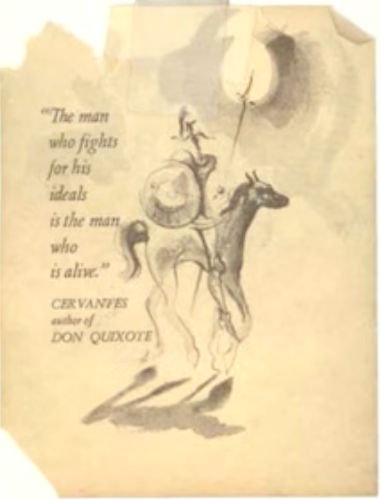
Patterson’s office art. A newspaper clipping that had been taped onto Patterson’s monitor for many years - blurry but worth it. Image captured from Francois Tissot’s excellent talk.
I had always believed that We the People would finally get climate change once we began to undeniably witness it; the science has been clear for decades, I just thought we needed to start to feel it to believe it. Yet here we are, human-driven climate change is manifesting before our eyes, and we are still not committed to action. My own beloved country elected Donald “Drill, baby, drill” Trump. Twice. But it’s time to wake up now. It’s time to shake off climate-change news exhaustion and disabling feelings of helplessness. Please, friend, set aside any shame you might carry for simply being alive in the times when climate change became urgent. We’ve been bombarded for generations by disinformation from industries that profit from fossil fuel use. It’s so difficult to know what to do when you're just trying to pay the mortgage, get to work, feed the kids, when it’s hard to even make it to tomorrow, and climate issues feel distant. For me, I had other work that drove me, and for decades I found it hard to look up from the computer to do much else. But if we can each take on just a little, learn what we can, share what we learn, and vote for those who would protect the planet, together we have power. There is still time to soften the blows of what is to come. Our world is vast and complex, so this moment invites many potential outcomes, better and worse futures, and the paths we choose now will shape the lives of the next generation. [e]
In considering what’s ahead, there is also, and this is no small thing, still time for our own dignity and the personal healing that comes through action. Still time for the hope infusion that comes from choosing not to be complicit, small act by small act. Still time for experiencing the sweet joy that blooms in standing together with the many lively and interesting people who are working to save our planet, each person unique in the ways they find to step up and into the fray.
The data is compelling, the science is clear, but the message is still being obfuscated by the companies and the billionaires that profit by keeping us dependent on fossil fuels. In their lust for ever more wealth through continued extraction down to the last profitable drop, the industry fights legislation that threatens to shave a hair off their profit margin, deliberately distorting economic impacts of environmental regulations to spread fear. Even if the proposed environmental legislation they oppose might greatly benefit the communities in which they operate (and sometimes live) by keeping the environment safer, and even if they could reduce the impact on global warming for the world they and their families also inhabit, they seek to maximize profit. One example of this I recently witnessed was the Clear Horizon Bill, SB18, which lost in the 2026 New Mexican legislative session. SB18 would have kept in check the worst pollution from the biggest polluters in our state and kept us on track with a 2050 net zero carbon emission goal, but it lost in the state senate due to a statewide disinformation campaign. [f] Citizens seeking and sharing truth in the face of this seems to me is the only antidote. Sometimes we win, often we will not. But we must be tenacious if those wins are to be enough to carry our children into a safer better future.
Trees and their forests help restore climate balance and some of us are seeing this, so I’ll end this on a story of the power and beauty in resistance. In 2018, the highest court in Colombia recognized Colombia's Amazon as an "entity subject of rights", essentially granting the rainforest the same legal rights as a human being. This ruling was taken because 25 young people from Colombia, ages 7-26 years old, successfully made the case that, “destruction of the Amazon jeopardized their futures and violated their constitutional rights to a healthy environment, life, food and water.” Think on it -- our world was taken up on a seven-year old’s shoulders, and that little person, together with 24 friends, supported by their families, enabled by the Bogota-based rights group Dejusticia and the law, found justice that helped carried the world to a better place. And this ray of hope continues to shine radiant. Building on this ruling, in November of 2025 Colombia became the first Amazonian nation to make its Amazon biome completely off-limits to extractive industries, and they are urging other nations to join with them in an “Amazon alliance for life.” And in April 2026, Colombia teamed up with the Netherlands to host the First Conference on Transitioning Away from Fossil Fuels. ¡Por la vida! ¡Viva la resistance heroica!
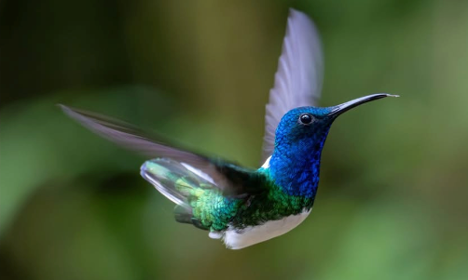
Small feathered emissary from the Colombian rainforest. A White-necked Jabobin. Photo by Melani King © from her collection, Hummingbirds in Colombia - a photo diary, April 2026.
Light Sparks Life: footnotes and asides
a) The great ages of the Universe and of the Earth. For many decades, I had kept the age of the 4.54-billion-year-old Earth tucked away in one compartment in my brain, and 13.78-billion-year-old age of the universe in another. Not so long ago I had an aha moment when I put the two in thought-proximity, separated them by a division line, and realized our dear, extraordinary, beautiful, life-charged momma Earth was a full one third of the age of the universe (4.54/13.78 = 0.33!!!!). Whoa!!!!! You may well have known this all along, but it took me half a lifetime to notice. Since I first realized how ancient our planet was relative to the history of the universe, it has really pleased me to think on it.
We know the age of the universe through several lines of reasoning. It must at least be as old as the oldest stars, so ancient aging stars give us a minimum age, both cooling white dwarves, and ancient small stars that have “dropped off the main sequence” which means they have stopped burning hydrogen (like the red giants). Also, scientists can estimate the expansion rate of the universe because galaxies further away from us move away from us faster than those nearer to us. People often use an analogy of a rising loaf of raisin bread to think about this aspect of an expanding universe – as the bread rises and expands, raisins that are close together move a little bit further apart, but raisins that are on the opposites sides of the loaf will have moved further away from each other in the same amount of time. The speed that a distant galaxy moves away from us is called a galaxy’s recessional velocity, and that can be measured as “red shift” in the light emanating from the galaxy. Light moves in waves, and as a luminous distant galaxy moves away from us, the light waves it sheds elongate, and longer wavelengths of light are shifted to become more red. One can run that expansion backwards to its origin, and estimate the time elapsed in the observable universe since the Big Bang.
We know how old our Earth is because of radiometric dating, using a clock based on the natural radioactive decay of uranium to lead. The timer is set when a crystal first forms; uranium was captured as the crystal formed, and within the confines of the crystal the uranium decays and the ratio of lead to uranium increases over time. The oldest rocks and crystals on the planet can be dated based on this ratio. The oldest Earth crystals that have been found are Zircon crystals, sampled in Australia’s Jack Hills, that formed 4.374 billion years ago. These crystals are not quite as old as the planet, as the earth was molten as it started taking shape. But there is another way to get at her age. Meteors formed as the solar system was spiraling into being, as the Earth was also taking shape. They have blazed into Earth’s atmosphere as shooting stars, offering us science, wishes, and beauty as trails of flames in the night sky. Some of them, the meteorites, have made it through the flames to strike our planet, and are rock time capsules carrying in a message from the earliest solar system. By comparing ratios of lead isotopes in meteorites, a gentleman named Clair Patterson was the first to resolve the age of the earth. He published it in 1956, and his estimate has held as correct for these 70 years gone by. Our beautiful Earth is 4.55 billion years old.
b) The Earth’s Flow. The understanding of the power of the forces in shaping the Earth and our ability to reconstruct the past of a place through the lens of the geological present came in part from the discoveries of James Hutton, who is considered the father of modern geology. His paper, Theory of Earth, presented these ideas and was first read in 1785 at the Royal Society of Edinburgh, and published in 1788. He ended it with, “…we have the satisfaction to find, that in nature there is wisdom, system, and consistency… The result, therefore, of our present enquiry is, that we find no vestige of a beginning, no prospect of an end.” Some of the data he gathered that informed his thinking came from a place called Siccar Point.
An extraordinarily beautiful recounting of his journey is the song “Siccar Point” by Dave Milligan and Karine Polwart. Their weaving together of writings from the time with their own poetry, and the haunting sweetness of Karine’s voice will carry you on the boat with James as he saw the world take shape, searching for meaning along the beautiful Scottish coast. As Karine Polwart sings, “The Earth is never still, it’s never still…”, its dynamics as ancient as the sun, Earth’s own music pouring forth slow and deep from the edge of science and mystery.
I’ll confess here that sometimes I hear music in my thoughts associated with ideas I’m trying to understand. So it was with carbon cycles. As I was reading over the past few weeks to better understand the slow carbon cycle, and seeking words to tell its stories, I would wake up hearing a long pull of a bowed bass in my imaginings, low and slow calling me through the dream time of morning. Its vibrations resonated with the tremors and quakes stirring, as the Earth shifted imperceptibly deep below. My imaginary bass’s bow changes directions up when I think of a mountain range thrusting skyward, the music changes note with the uplift, and the world responds with the tremble in the air as mountains are born that can change everything. I have a particular love for the bass, and so I’m unreasonably happy immersed in these waking dreams. I hit the snooze button on my alarm and linger while riding this long slow note through my thoughts into the beloved Sangre de Cristo mountains around me, which formed through plate tectonics as heavy sea plates from the south collided with an ancient continental core to their north, the boundary of the old continent and ancient sea in Wyoming. A great uplift occurred. I imagine the mountains still shape-shifting in their long slow dance with time. The Earth is never still.
c) The lungs of the Earth. The metaphor of the rainforest being the lungs of the Earth is a lovely one, and embraced by many, but for it to hold scientifically, it is important to note the rainforest does not produce excess oxygen over what it takes in. This has been a point of some confusion leading to an incorrect notion that the Amazonian rainforest produces 20% of the world’s breathable oxygen. Because of this misconception about oxygen, some scientists say we should not consider the rainforest the lungs of the world. Scott Denning offered a thoughtful perspective on this perspective as he was trying to allay concerns that the extreme fires in the Amazon might deprive us of oxygen. There are many tragic aspects about burning the rainforest for agriculture not only diminishing of a vast carbon sink that is losing its capacity to temper the impacts of global warming, but also simply the loss of biodiversity, the loss of beauty, the loss of life. Still, we will have enough breathable oxygen even as the forests burn. In fact, breathable oxygen is quite stable in our global atmosphere, and most of it was originally derived from the oceans.
On the other hand, if you don’t only see it in terms oxygen intake and output, in some ways the metaphor holds. About a third of land-based photosynthesis occurs in tropical forests, and the largest of these forests is in the Amazon basin. The rainforest plants produce vast amounts of oxygen, they also consume vast amounts of oxygen, as do the microbes living within them, and so this is balanced so that net production of oxygen from the rainforests is near zero. Still, if one sees the breath of the planet through the lens of the green leaf, photosynthesis in plants giving off oxygen, all the while plants are also taking oxygen in, and this means there is a lot of oxygen exchanged at the boundary of air and life that is the rainforest’s own leaves. Our lungs serve as our living boundary between the air and our bodies. And there is a heck of a lot of green leaf in the rainforest exchanging air, both creating and drawing in O2 molecules fueling life. And, further, net CO2 from the air is flowing in through the green in the great rainforest. And so, to me, the lung analogy still holds poetic grace, it just depends on how you look at it.
d) Getting the lead out of gasoline. Clair Patterson, who discovered the age of the earth [a], also showed that unregulated industrial use of lead in gasoline was poisoning the atmosphere, the sea, and living things (ourselves among them). His activism made the world pivot to a better path. Patterson’s work did humanity a great service; I imagine he must have had a mind as beautiful as the shooting stars he studied.
When Patterson first published the environmental importance of lead contamination in 1965, his resolve immediately came into play. According to Francois Tissot’s recounting of the tale, the gasoline industry initially responded to his work by trying to bribe him by offering him lots of research dollars in other areas if he would just stop working on lead. He refused. Industry then countered by terminating grants he already had. He was undaunted. When those two tactics failed, industrial representatives went to the President of Caltech and tried to get him fired. His department chair defended his job, and he persisted. When the chemical/gasoline industry couldn’t silence him, they started to spread lies and disinformation to discredit this work. He kept speaking truth. And the truth finally won.
But Patterson also needed support from the scientific community. He was not a biologist, and so his case was aided when, in 1979, American pediatrician Herbert Needleman analyzed the lead content in the teeth of schoolchildren and showed that lead exposure could rob children of IQ points and cause serious behavioral problems; this science got people’s attention. Lead is very toxic, and by this point, by 2026, thousands of scientific studies have shown that lead exposure can cause serious health and mental health issues, and that children are the most vulnerable. Unnervingly, lead exposure has even been correlated with violence in humans.
Through a friend of a friend I had an opportunity to ask Patterson's son Cameron Patterson about his father. He described his dad's achievements in this way: “He was a pure scientist through and through, separated from the advocacy of environmental activism by a powerful personal fundamental motivation of scientific curiosity and the thrill of scientific discovery. He is credited with determining the age of our solar system and therefore the time since the earth and planets of our system precipitated from star dust. That was based on the original scientific thinking of those who came before him, and he solved the problem (by building a clean lab) with dogged determination and curiosity. I think his most creative scientific achievement was when he realized that the same methods and tools he used to date the earth could be used to help understand the global impact of hominids on terrestrial ecosystems.”
Though lead poisoning is still a problem, leaded gas is no longer a source of pollution. Humanity did it; we came together and we changed the air we breathe. The parallels between the story of leaded gas and the broader story of climate change are both striking and hope-worthy. We have known for decades that greenhouse gas emissions are placing a burden on our planet, but progress has been hampered by those who profit from the status quo, just as it was with leaded gasoline. Through the Paris Agreement, (as was done with the Partnership for Clean Fuels on Vehicles), we forged a global alliance to stop polluting our air with greenhouse gases; it offers a reasoned path forward, though it faces many challenges. Now it is up to us to get it implemented.
e) Next generation, definition from the Bette Korber dictionary. All those cute little rascals running around under our feet, our children, our grandchildren, our smallish friends. The little bums making a ruckus at the park, at the swimming pool. There they are, teeming under the crossing guard’s sign as they make a quick get-a-way from school. There they are refusing to eat their vegetables (again). Our little doves. The neighbors’ kid. They are the ones you would give your life to protect. They may be in your family, constant companions. Or, you may not actually know one of these small exotic creatures personally, and you may like it just fine that way. If that is the case, I invite you to love them (or at least tolerate them well) in the abstract, at a safe distance. That’s enough. That will do. But remember them, always.
f) Clear Horizons, a Bill that failed to pass – this year. My home state, New Mexico, sits on major fossil fuel deposits in the Permian Basin and San Juan Basin, making us a major producer of crude oil and natural gas. We also have a wealth of potential in wind and solar energy, so my beautiful home state is a key player in our energy present and future. Despite these resources we are also a poor state, and so the shift to renewable energy needs to be done mindfully of the economic well-being of our people; that said, the people of New Mexico deserve a clean water and air, now and in the future. Thus, in our state, the debates around extractive industries are intense as legislation related to this topic is considered; there is a lot of money at stake, regional jobs, but also the health of the people and of the land.
Here the story of a single bill, the Clear Horizons Senate Bill 18 (SB18), that was considered in our 2026 legislative session and failed. In my opinion, the failure was due to a misinformation campaign. The Bill would have codified into law New Mexico Governor Lujan Grisham's 2019 executive order directing the state to reduce climate pollution by 45% by 2030 and reach net zero emissions by 2050, keeping New Mexico in line with the Paris Agreement, and would have reduced the worst pollution from extractive processes. Thanks to the executive order, in 2026 we are currently on track for net zero emissions by 2050 in New Mexico. Our governor’s plan is well underway and working, but she will have reached her term limit this year, and her executive order will end with her term. Meanwhile, fossil fuel extraction industries are prospering within the constraints imposed by the order, and our state’s agricultural sector was well ahead of the 2030 goals.
The point of SB18 was to translate the governor’s order into state law. Polling suggested 75% of New Mexicans supported it, and many of us were passionate. A faith-based group of pilgrims walked 320 miles from the polluted air of the oil fields of southern New Mexico to our state capitol to support the bill and clean air. As the bill was moving through committee in the Senate, I tried twice to speak in senate committees for SB18, but the rooms at the legislature were so packed with citizens waiting to speak that I never made it to the microphone. Still, it felt good to raise my hand and be counted in support of SB18, and I was fascinated by the discussion. The citizens who stood with me spoke with reason, hope, and with good science behind them. Two minutes each. I was moved to tears multiple times through the hearings. Applause and cheers are not allowed in the formal setting of the legislature, but when a particularly compelling point was made fingers would quietly snap like a thousand butterfly wings all around the room. The bill would have provided a legal framework to continue to give us achievable goals that are in keeping with the international consensus of what is needed to combat climate change through the Paris Agreement. I learned through discussions in committee that 21 other states have passed legislation like SB18, so while Trump has withdrawn our country from the agreement, state-by-state much of our nation is still aligned with the rest of the world in this.
The oil and gas industry made it sound as if their industry would be financially ruined by the bill, but in fact the industry is not only successfully operating under the governor’s executive order, which SB18 would have continued, it is thriving. The state Environment Secretary, James Kenney, spoke as an expert witness on behalf of SB18. He said his office had modeled the consequences of taking no climate action, and that by 2050 if we took no action, it would actually cost New Mexico $294 billion dollars in terms of infrastructure damage, air pollution, health impacts, and extreme weather. He added that taking action on pollution control and climate change though a bill like SB18 can actually create jobs and shared an example: under the governor's current order, jobs in methane mitigation are growing fast in the Permian Basin.
Big oil mounted a million dollar misinformation campaign to convince many small business owners throughout the state that they would be financially ruined should the bill pass, and the ads worked. Many citizens like me, but on the other side of this argument, showed up during the legislative session to speak against SB18. They expressed their heartfelt fears: that they would lose their small restaurant, lose their job in the oil industry, or lose their small farm. Some tribal people believed they could no longer burn wood to heat their homes in the winter if SB18 passed. None of these fears, though genuinely felt, were justified; my reason for knowing this was both reading the bill for myself, and because of the detailed careful economic analysis presented by the state at the hearings, and because of excellent reporting on the bill. Despite industry claims to the contrary, only the largest industrial polluters in New Mexico would have been impacted with the cost of keeping their operations running clean.
Still, fear took the day. SB18 was defeated.
So, the good people of New Mexico will try again next year, and I’ll be with them.
A postscript: I was deeply grateful to the New Mexican, our Santa Fe capitol city Newspaper, and Source NM for their incredible coverage of our legislative session, including SB18. Also, I’m so grateful to the leadership of the Sierra Club, particularly Camila Fiebleman, the Sierra Club Rio Grande Chapter Director, and many other New Mexico environmental groups, for their guidance. YUCCA has also been a great source of political information and inspiration; the young people are spitfires, I love them! They kept folks like me up to date regarding when to show up to listen and speak, which legislators to contact, when to be there to rally and protest, and they also provided many opportunities for experts to share their knowledge so folks like me could get accurate information via webinars. And I’m grateful to the NM legislature for letting The People have a voice. Even when my side loses, I am relieved we can still speak out, and good changes in the law often take many years of many of us trying.


Beate and Tim’s legacy.

The “grandchildren”. The taller spruce and firs were from Beate and Tim’s original planting, but the little ones recently came in on their own. They are wrapped up in the white mesh for extra protection while they are so small and delectable, so the deer give them some time to grow. valley.
Las Conchas Fire near Los Alamos. By Michael Zeiler, June, 26, 2011, the view from across the valley.


For James and Boo, the Pacheco fire. Painted by Joanne Topol © 2011. As we were moving into a new home in 2011, the Pacheco fire was burning. I sent photos to my dear friend Jo, and she got what I’m sure were too frequent updates from me, as I was afraid. She is an artist. With some trepidation (would we want to be reminded?) she sent my husband and me back paintings of the fire as our “housewarming” gift. We were safe from the flames when they arrived, so we had the luxury of loving the paintings. They still glow hot, there in the corner of our dining room, reminding us.e
The 2011 Las Conchas Fire. It burned more than 150,000 acres in the Jemez Mountains © Kari Greer, US Forest Service

“Our experience of fire occurs in the realm of the visible, but it is made possible by the invisible, and there is a world of energy in the vaporous, unseen realms. It is not the tree or the house the burns, but the gases those things emit. That is what the heat is for: to liberate the flammable gases from their solid or liquid prisons by transforming them into vapor. In fire’s world, everything relevant is breathing, emitting, vaporizing, volatile—not just the air, but the tree, the neighborhood, the house, the Formica countertop, the bag of cat food sitting on it, and if the conditions are favorable enough—and hot enough – the cat itself. The higher the temperature, the broader the fire’s menu…”
- From Fire Weather, by John Valliant
IV. Touched by Fire
Personal stories: fires too close to home and how climate change fueled the blaze
Fire, Earth’s wild lover, had once been tender when it passed through the Jemez mountains. For 10,000 years, it traveled in on lightning and visited often, and when it came through it burned with a caress that held the power of restoration. The forest fed the fire, the fire fed the forest. But over the last 150 years, the weight of our human presence has changed the nature of the forest. Before, great trees were interspersed with meadow and velvet grasslands that shaped the life on these mountains. Over time, these woodlands transitioned to densely packed mixed conifer and ponderosa pine forests. The fire resilience of the past, the partnership of life and fire, had been transformed by over-grazing, over-logging, and the quelling of wildfires for over a century, creating a forest primed to burn hot and furious when ignited by the touch of flame. So, when Fire returned to these waiting lands, as it was bound to eventually, its flames found purchase in a landscape too thick with trees and with a tangled undergrowth that had been made crisp and parched by drought and so turned into living kindling. When the spark came that ignited the flames, Fire flickered awake and breathed in air that was dry and hot and fire-welcoming. Fire smoldered and stretched and sampled the landscape. It found it to be perfect. Fire had arrived home to the Jemez, but with a new violence, a searing intensity that left devastation.
The forested land I knew so intimately, that shaped my home, offered itself to the flames. Here the thin layer of life that drapes the mountains between the soil and the sky was exploding. Yesterday this blanket of living Earth was all color, vivid and awake in a thousand forms, the breathing networks of living nerves that hold memories of love and thirst and awareness. Today all became flame; flames darting through the undergrowth, climbing up the branches of smaller pines, transforming the forest canopy into a crown fire. Life was reshaped into twisting funnels of ash spinning skyward, embers carried on the wind to advance Fire’s claim on the mountains.
My small town, Los Alamos, is nestled onto three mesas formed long ago from volcanic lava. The mesas reach out eastward from the Jemez mountains towards the Rio Grande River and the Española valley below. The neighborhoods on these mesas were tucked between patches of forest interleaved with golden canyons. The day Fire came, the flames in the Jemez were moving fast down paths of parched and vulnerable wilds towards town. The state police were cruising the town’s streets calling for the obvious, immediate evacuation, their voices surreal and mechanical amplified through megaphones. Easing into the slow line of cars and getting down off the mesa was the pressing matter of the moment. Panic manifesting in my fingers, I gripped the steering wheel painfully tight. I willed myself to relax, just breathe, just breathe, just breathe, unclenching each hand one at a time. But then I would look back into the canyon’s folds and up the mountain into the blazing face of the beast glowing bright and savage, vivid where the radiant flames shone through billows of grey smoke. One look at that and my hands would again cling to the steering wheel as if it held salvation. The sky was filling with thunderheads building in response to the flames and towering over the mountains behind us, cloud-dragons that were wind-howling, made of light and ash and shadow.
Smoke is the smell of fear. I inhaled the ashes of ponderosas, deer, butterfly, of horse and squirrel and columbine, ashes of the fierce man who would not evacuate, and ashes of the old man who could not. In their next incarnation all of these would become cloud and thunderbolt. [a]
How could a fire move so fast? Ponderosas would catch the red and glowing embers, as the hot wild wind coursed through their branches. A magnificent living tree could in a moment be transformed into a pillar of flames. The heat of the fire was creating its own wind, sucking oxygen in great heaving breaths that drew air up the canyon, feeding the inferno on the mountain. The forest was so dry after months of no rain. The crown fire arced overhead while the ground fire below was fueled by deadfall and dry brush. Moisture in the air was just a memory.
Our small hospital was perched on the north rim of the canyon. The fire was tasting the treed slope that was the center of the canyon and skittering up its walls towards town. Passing by the hospital, we could see the staff and the fire crews evacuating the patients. Some were tethered to oxygen tanks, some in wheelchairs hurrying down the ramps with a nurse steering. Some of us pulled out of the crowded line of traffic. Can we help? How can we help? Please dear God can we help? We can make room in our cars. Some boxes of old photos were set aside there, records and paper memories left for wind and flames, as a passenger seat was transformed to a portal to the valley below, to a place the fire wasn’t.
Then, in that frantic moment, time slowed. Making her way down the stairs by the hospital entrance, a woman in a hospital gown showed up. One slow step at a time she walked. She was singing. She was using that most ancient of musical instruments: her breath. It unfurled from open lungs, past the perfect shaping of her throat that burned with the breath of ash, and through the carefully rounded chamber of her mouth; the sweetest notes poured out into the parking lot. She reshaped the air around us. Amazing Grace pushed back against the fear and cleared a path to the valley below.
It took weeks to wait out the fire. Time itself was changed by the smoke, it was slowed down and made dreary and heavy, burdened by sustained fear. The day finally came when we could return to see what was taken and what remained. The scale of the fire was unprecedented in its time and taught us what heat and drought combined with a century of fire suppression and overuse of the land could awaken: walls of flames coming into town. Much was lost. Four hundred families’ homes burned in our small town. Strange patterns were left, ash and cinder demarcated puzzles of grief and reprieve. A block of homes burned to nothing as the fire spread from structure to structure across the ground, while the surrounding Ponderosas were left untouched. One house taken while the house next door was left intact, a spark in the wind discovering its potential in a wood pile or dead leaf cover changing the fate of a family for years to come. A foul smell still emanated from the burnt structures, a sickening smell of torched plastics lingered.
The nature of the healing ahead was uncertain when our evacuated community first came back and began wading through the ashes. Many families took refuge in FEMA trailers, pressed into makeshift communities in a hot and grim vacant lot. Over a few years, their houses were slowly rebuilt on the foundational memories of hundreds of lost homes, but the initial trauma of the fire carried a continuing burden for years as they struggled to deal with insurance and FEMA and restoration of a sense of home. The healing was slow, first realized in wildflowers, then in aspen, finally to be measured in a generation. Now young aspen and wildflower cover what was ponderosa forest. The young people in the community do not have a memory of this, some are not even aware of the history. But the old among us look up to the bare mountains and cannot forget, though the details recede with time.
My neighborhood was spared, but my community was not. And I remember a great old Juniper that had lived nearby. Nothing left after the fire but branches of silver and black twisting skyward, bare as bones, graceful in death. You were ancient and beautiful, old tree. Your bitter berries had fed many generations of bear and bird, coyote and hungry deer. You got them through the lean cold months as fall turned to winter. When the fire came for you, you warned them to run, to fly, by the scent of your own burning as the flames explored your heartwood and you were remade as smoke and ash. You burned hot, as you were made for the flames, a volatile and stationary being. Those you once fed, however, were built to run and to fly, and so they carried the grace of your living forward as a memory of a berry-filled belly. The knowledge born in your smoke guided them to safety as the fire came. The mice would have tucked in underground, found survival curled in your deep roots as the fire swept the surface above, tiny hearts pounding, choked with smoke, hot but breathing - you were always a sanctuary. Perhaps the memory of place, essential as stone and intangible as air, holds a kind of memory not bound by firing neurons but instead just held quiet in the past; the time I paused to crush a berry that you offered between my fingers, delighted in your heady incense, lingers. There is comfort for us, Juniper, in the new growth in the fire scars, your ashes turned to soil. There are some young trees here, alive but struggling. Our place, yours and mine, was ever changed the great fire that was a harbinger of things to come.
The following story is not the story of one fire, but a fictionalized composite of my own memories of three fires in and near my Northern New Mexico communities. It weaves in my stories, stories shared by friends, and it also refers to a few things I later learned about the nature of wildfire that explained what I had witnessed. While the story is not the memory of a single fire on single day, it holds its own truth expressing how the fires I've experienced felt to me, memories melted together and still smoldering. So, this is how I think of them now: with fear.
- Bette
The old trees in the mountains tell us precise stories of the long past of our homelands through the science of dendrochronology, the study of tree rings. The reconstruction of patterns in ancient wood preserved in the dry climate of the Southwest provide a 2000 year time-travel journey, mapping the history of rain by the trees’ growth rates, and of fire by their trail of scars. They teach us. We need to heed their inherent knowledge to find our way back to a more sustainable way to live. The forest of the 1800’s held fewer than 100 trees per acre - in contrast, by the 1990s, tree density in stands of ponderosa pine in the Jemez could exceed 2,000 per acre. In their historical setting, grand old fire-resistant trees would have been lapped by fire at their feet. Fire-prone grasses and brush naturally thrived in these woodlands, plants that evolved to be restored by fire, and the sunlight and fertile land that nurtured them was refreshed by the burning. Fire used to naturally sweep through the high mountain forests in the Jemez Mountains every 5-20 years. The native peoples who lived in the Jemez, and across this region, not only lived with these natural fire cycles they nurtured them, and traces of their controlled burns are captured in the tree rings and regional archeology, through charcoal remnants of fires past, and in the stories passed down through the people of the Jemez Pueblo. Their intentional low-intensity small fires would clear the undergrowth, leaving the old growth unharmed, opening seeds, letting in the sun.
It isn’t only the fuel loading of our forests since we began suppressing fires in earnest that is creating the conditions for mega fires. It is also global warming. Air holds more water when it is warmer, as the atmosphere and the earth are in a constant and dynamic exchange of water. On a hot day, the balance of water is shifted out of the earth and the plants and up into a thirsty sky; as trees and plants dry, they become more flammable. Also, dead trees that have succumbed to decades of increasing drought now pepper the forests. Fire seasons start earlier and end later, until fire seasons are now merging into fire years. As we drive the warming temperatures by driving climate change, we create the conditions that feed the catastrophic fires. Before these fires are contained and controlled, many leave behind scorched earth that burned so hot that even the pyrophytes do not remember how to recover from the flames. (Pyrophytes is a word from the ancient Greek, pyro means fire, and phyte means plant; they are the plants that have so adapted to fire that they require fire to live.)
As I am writing, spring has come far too early to my beloved New Mexico. It is utterly beautiful this March day, with its warm breeze, its blossoms and bees. I try to experience this day in the moment, but I can’t shake the feeling that March feels unnervingly like May. It should be cold. After a winter of almost no snow, our forest is drier than any spring in my memory. And fire and water are intimately linked, call and response through our planet’s seasons, so I know the lack of winter snow is bound to the risk of summer fire. I take a break from this writing to go sit down on the porch, to read the newspaper with my morning coffee. Barefoot on warm stone, and in sleeveless shirt, I have a go at forgetting fire for the moment. No luck. The front page is dedicated to the little town of Truchas, a very old and beautiful traditional farming community tucked high in the mountains above me. Winter has always buried Truchas in snow, but last winter the snow did not come. The elders there cannot remember such a dry winter. The winter snow melt has always brought essential water to the small farms; the snows are life-giving. The people of Truchas, who share and manage together ancient irrigation systems called acequias, water their fields and their animals with the clear sweet waters that come tumbling down as snow melt from the mountains in spring. For as long as anyone remembers, mountain rivers filled their acequias for spring planting, providing a conduit of life from mountain peak to farms lasting until the summer rains arrive to refresh the waters once again. Agua es Vida. This year, with almost no snow, the people of Truchas are trying to plan how they will share the trickle of water in their acequias as they pray for rain. This morning, I set down my coffee, close my eyes and share their prayers.
Not only is the lack of water threatening their way of life as farmers, but the lack of snow brings to all of us here on the mountains edge an all-too-reasonable dread of coming fires. Already this year scattered fires have been erupting in these mountains and it’s just March; so far, each fire has been quickly contained, but it feels like just a matter of time. Fire is already tasting the dry in the mountains. Just as I remember best the fires that I have known up close and personal, the people of Truchas will remember the Calf Creek/Hermits Peak Fire of 2022, the largest fire in New Mexico’s history. It decimated communities neighboring tiny Truchas.
With the droughts and the heat, our Western mountains are ever-priming for the next fire. And these new fires of the 21st century can burn so hot they not only kill seeds but sometimes even roots under the surface of the soil – the forests of North America are losing their resilience. Further, the restoration of the land after the flames sweep through is burdened by drought such that the landscapes often come back incomplete and broken, vulnerable to non-native plant species like cheatgrass, plants that cannot feed the insects and animals which evolved to thrive in a very different world. To try to help such lands recover, the unsung heroes of our Forest Service continue the hard work of gathering and preserving the seeds essential to restoring the lost forests. But their crucial work is being undermined by the Trump administration’s cuts, and the DOGE 2025 firings of many people with the expertise to implement the programs. These workers include the pinecone cowboys who climb the tall conifers to gather healthy seeds; the people who mind the tree nurseries and grow the seedlings; and the people who do the very hard work of replanting, seasonal work done mostly by migrant workers on H-2B visas - yet another reason to be grateful to our immigrant population.
Still, the people who love these mountains labor on, learning from the history of fire and infusing the scorched earth with their knowledge, with new seed, and with reasoned strategies reforesting what we have lost in new ways that consider future resilience to our changing climate, and rehabilitating forest that remains at risk. Some of these people work through non-profits, some through governmental programs, and some through tribal efforts. There is a growing unity among the three, and sometimes these combined efforts are met with great success.
Meanwhile, other people work for the future by tending their own land. The response to the Las Conchas fire by my friends Beate and Tim is one such story. Both were academic scientists who spent some summers working at Los Alamos National Lab; my husband James had the great pleasure of working with Beate. Their love of the beautiful mountains of New Mexico culminated in them buying a cabin in the Jemez mountains, and they have continued to summer in here even after they retired. The Las Conchas fire took their summer home and the forest around it. The fire burned so hot that seeds and roots of the trees were killed. They inquired, but USDA NRCS could not help them. With a stubborn tenderness hard to fathom but beyond beautiful to witness, they took on the restoration of their 7 acres of land. Finding a source of seedlings through the New Mexico Conservation Seedling Program, they planted 1400 native tree seedlings. They learned through their work: planting with a 6" auger, a tree protector and a bamboo stick increased the survival rate of their trees significantly. For three long years after planting, the little ones needed water. Beate and Tim did not have running water, they trucked in their own water for drinking and living. They began to cart in enough extra water for the trees, and they hand-carried the water to each of their 1400 thirsty little ones - twice a week - through the summer.
They had a very good success rate, as 400 trees survived the early years, despite an expectation of only 10% surviving; they must have been very good family to these trees. These 15 years since the fire have given them trees taller than themselves, green crowns against blue skies when they look up. The trees have reciprocated the grace of giving in their own way, sharing with Tim and Beate the shade and the coolness their proximity offers. And Tim and Beate have grandchildren! Little trees they did not plant are now beginning to show up scattered throughout the property. Their fur-covered neighbors seem to appreciate the awakening forest around the place - mountain lion and bear come by to look on though they keep a respectful distance. Some of their human neighbors have also noted the transformation, and Beate and Tim have been sharing seeds and knowledge. I love thinking of the forest renewing around the epicenter of Beate and Tim’s devotion. Engelmann spruce, ponderosa, Doug fir, white fir, limber pine, the blue spruce delicate and so thirsty and demanding special care, all these have come home. The tough little Gambel oaks and graceful quaking aspen that came back on their own. There are a few extra ponderosas in the mix, as Beate is particularly fond of them even though they make her sneeze - a small price for love. As it turns out the ponderosas may be deserving of some special attention, as they are having a hard time of it, and the earth needs their continuing shade. Beate and Tim are a blessing to the Earth.
My family and neighbors, like so many people in New Mexico and throughout the west, live on the urban boundaries of wildlands that had originally evolved to be frequent-fire forests. This means we are blessed to live in beauty, and we are cursed to live in worry. Since 2000, three fires have threatened my home, my town, my workplace and my capacity for hope: The Cerro Grande [b] and Las Conchas [c] were both megafires in and near Los Alamos, in the Jemez mountains, and the smaller Pacheco Fire [d] burned in the hills above us when we first moved to Santa Fe from Los Alamos. I’ve faced the fear and disruption that comes with evacuation, and I’ve witnessed the hardship of friends who lost their homes either to the flames or to the floods that follow the fires. Given this history, I watch with an unrelenting panic when wildfires devour other places I know and love. Whenever parts of California and Montana are taken up in catastrophic fires I feel the heat of the inferno 1000 miles away. As I lived in the greater Los Angeles area for my first 30 years, even from the safe distance of New Mexico I could not turn away from the terrible news out of LA during the Eaton and Palisades fires in 2025.
Like a phoenix from the ashes, one powerfully good thing came out of LA fires: new science. Because Caltech was adjacent to the Eaton fire, the scientists there could mobilize, and they learned what they could during the fire and in the immediate aftermath. Because they were on it, the world now knows more about lead and other toxins left in the aftermath of urban fires, and more about how debris flows are channeled when the rains come after a fire. The response of the scientist was so quick and so agile they were able to help in their own communities in real time, but the legacy of their work will impact how we can prepare for and respond to the catastrophic fires ahead.
a) The people in the story. The 2 people who died in this story did not die in one of the three fires I knew best in New Mexico but instead represent people who died in the 2025 Eaton Fire in LA, I put them into these New Mexico flames to express my complex feelings about friends who decided not to leave their homes during the fire evacuations, and also to honor those who made sure their neighbors who needed help made it out. Although I do not remember Amazing Grace being sung, the song is sung in this story to honor the brave firefighters who gave us a path to safety and protected our town at their own peril. Bless them.
b) Cerro Grande Fire, Jemez Mountain NM, May 4-July 20, 2000. The Cerro Grande Fire started in a controlled burn, but as Tom Ribe writes in his book about this fire, Inferno by Committee, the story behind the fire is complex. Four hundred families lost their homes in my small town of Los Alamos, New Mexico. Everyone who lived there was either impacted directly or knew someone who was. Not only my community, but parts of Los Alamos National Laboratory were threatened. The buildings I worked in were in peril, and they housed the computers that held my life’s work to that point, as well as the work of my team and my colleagues, a global repository of HIV data. Under evacuation orders we weren’t allowed access to the area. The year 2000 was a time before The Cloud, and while everything was of course backed up, the backups were all in close physical proximity, and unnervingly near the fire’s front lines. And so, we waited and worried from a distance, and watched riveted to the local news as flames took parts of our town and the laboratory and devoured the mountains above it. Until the fire was contained, there was an ongoing fear that nuclear and chemical waste repositories would be breached; although they were not the fire fighters had to bear the extra weight of that concern as they worked. The fire was vast, and other communities were also damaged by it. In particular, Santa Clara Pueblo was impacted, and since Cerro Grande in 2000 the pueblo has been in the path of multiple megafires. They are stewards of these lands, and work to restore their lands and waters with labor and love, using both science and traditional knowledge. The Cerro Grande fire was terrible in its heat, and it raged through 58,000 acres, leaving a billion dollars of damage in its wake. It was an eye-opening and relatively early example of what western catastrophic fires to come would look like in these opening acts of climate change. Welcome to the 21st Century.
c) Pacheco Fire. June 18-30, 2011. By a twist of fate, in mid-June 2011, my family was moving out of the path of the Las Conchas Fire (described below in part “d”), just before it started, although we still worked in Los Alamos at the laboratory. Our new home was near the lively city of Santa Fe, in Tesuque, within an easy commute from our work at the Los Alamos lab. We unloaded our moving boxes from the truck and began to settle in. As we were unpacking, hikers were exploring the local mountains and canyons above us, behind the crest of a hill just to the northeast. In the cool of the evening, they decided to build a campfire, cozy against the darkness. The sparks of their fire would have swirled skyward in the wind, as sparks do, glowing orange and flickering bright against a backdrop of stars. A spark or two darted into some tinder (given the whole forest was tinder at this moment, it wasn’t hard for a spark to find some), and a new little flame started to propagate unnoticed outside the protective circle of stone that bound their campfire. The Pacheco fire started to stir, blinking its ember eyes open. We woke up the next morning to a clear blue sky, but by afternoon felt the remembered burning in our throats and caught a whiff of dread. The beautiful blue of the New Mexico sky was transformed as we watched, smoke spilled over the hills and settled into the canyon where we now lived, and by evening we were immersed in a grey-brown haze. The news came in by emergency alert that we were in evacuation holding pattern Level 2, the “Set” stage in “Ready, Set, Go!” So, we prepared as we could, and then we “Set”. And Set. And Set.
Each day felt like weeks. Finally, the flames began to head away from us, artfully turned by the master firefighters who protected us. The firefighter in charge of communications spoke to us on a YouTube broadcast every evening, fully suited up and fresh from the front lines. He spoke to us about their strategies as fire herders, their progress, the fire’s acts of rebellion. When he started giving these updates, he sounded a little shy, awkward with this very public role. By the end of the fire, he was charming his grateful audience with beloved and bashful attempts at humor to get us through our worst fears. He and his team successfully shifted the path of the flames away from Tesuque and away from the Santa Fe watershed, protecting the river that is an essential water source for the city.
d) Las Conchas Fire, Jemez Mountain NM, June 26-August 3, 2011
“During the first 14 hours, the fire raced eastward, consuming more than 43,000 acres of forest and destroying dozens of homes. The speed of the fire’s spread was astonishing — averaging an acre of forest burned every 1.17 seconds for 14 straight hours. The fire continued to grow over the next five weeks and was eventually contained by USFS firefighters on August 1st at 156,539 acres.” - Notes from the Las Conchas Fire, the Southwest Fire Consortium
A tall aspen was taken by a gust of wind into a power line, and it awoke the Las Conchas Fire, flames spitting into the wind. That fire moved fast; the Los Alamos National Laboratory and town site were evacuated again, as they had been 11 years before. As the Las Conchas fire began, we were still living and breathing in the smoke and feeling the receding fear of the Pacheco fire. As people raced for refuge away from Los Alamos, we took some newly arrived summer students with no place else to go into our new home in Tesuque, and we all made do. Long summer evenings were dreary with worry; we drank too much and watched the plumes of smoke over the Jemez in the distance.
The fire burned 156,000 acres, including much of Bandelier National Monument; during its first 13 hours it burned almost an acre a second. Flash floods followed and continue to be a risk. The Rito de los Frijoles, the sweet little perennial river that once provided water to the people of the ancient pueblo in Bandelier (occupied between 1150-1500 CE), has been laden with debris from the post-fire flooding. It so clogged that it is no longer is perennial. The last time we visited, the only surface water to be seen was a murky pool adjacent to a dam of a brave and stubborn beaver.
Sixty-three homes were lost to the Las Conchas fire. The community of Los Alamos, as well as Los Alamos National Laboratory, were mostly spared. This was mostly due to the burn scars of the Cerro Grande fire blocking the path of the Las Conchas fire into town, but fire treatments conducted during the decade after the Cerro Grande Fire also helped. I was better prepared for evacuation this time; my team and I had learned some things. Our computers were backed up at multiple locations, some international. When the laboratory was evacuated, we at least did not have that worry about the possibility of losing years of work, and we had our laptops with us to keep working while we waited and watched.
Touched by Fire: footnotes and asides
V. Ideas for Climate Activism in 2026
“Please don’t give up, please don’t lose that sound
So many people fought to gain that ground.
Please don’t give up, please don’t hide your voice
So many people did not have that choice…
She told me the power of song was in the unison
She gathered her friends all around her
And they pierced the sky with a call.”
-- Lyrics from the song Bellow by Moira Smiley
Getting out the vote. While there are myriad problems confronting us when it comes to taking political action in these turbulent times, two issues stand out to me. First, any political action is daunting when just getting by day-to-day is so difficult for so many people, with food and gas prices shooting up, cruel cuts to healthcare and childcare beginning to be felt, and the fact that a full time job at minimum wage is not enough to pay the rent for a two-bedroom apartment in any county in our entire country. Many of us work so hard we have no energy to spare outside of our jobs. Second, many of us who are on the left or at the center politically feel like we are being pulled in a thousand directions at once with President Trump’s destructive and vengeful free-for-all of a presidency. Every day we learn about a new outrage. It leaves so many people that I know and love feeling overwhelmed and helpless. But we are not helpless when we stand together.
There is a unifying strategy we can use to gain some ground on all fronts at once if we act together: come November, we need to bring a Democratic Congress into the majority, so that Congress has the will to restrain Trump. Thus, I would say first and foremost, VOTE! Are you registered? Can you make sure your friends are and families are registered? If, like most Americans, your main issue is the economy and affordability, you will likely want to vote for people who will push back against both the tariffs and Trump’s Iran war. The beauty is this: if you vote for people who will stand up against Trump in those arenas, you will also be voting for people who will be able to stand up in other ways, including good environmental policy. It’s a win-win. So, this is fine recipe for resistance. So, as I’ve said and sung before: learn, think, speak, and vote. That is solid. I think at this moment, getting out the vote is our best chance on all fronts.
For me, climate change has been a lifetime frontline issue, but I see a new urgency due to Trump’s pro big-oil, anti-regulatory agenda. Trump has systematically been destroying our governmental and the scientific capacity to monitor and respond to climate change and pollution. It started with Elon Musk’s DOGE mass firings in the DOE, the Forest service, NOAA and the EPA; decades of loss in critical human knowledge will result from this loss of expertise. Further, the administration refuses to spend the money appropriated by Congress to enable the regulation of pollution and to support clean energy transitions. Though of course the legality of this is questioned in the courts, much is lost through the disruption, and restoration of what has been lost may not be possible. His administration is opening millions of acres of our public lands to gas and oil drilling and mining. There is no going back when our pristine lands and waters are lost.
But many other issues are also burning right now: the horrors of the Iran war and Trump’s abusive aggression towards our international friends and allies; his open threats to our democracy; his attacks on the immigrants who are part of our communities; ICE, whose officers have been allowed to intimidate and even murder Americans; Trump’s vitriol fueling sexism and racism, and legitimizing hatred towards gay and trans people; his disrespect for and defunding of the sciences across many fields; his attack on our universities and our free press; his scaling up of nuclear weapons production; his un-fettered welcoming of AI no matter the costs… we desperately need a Congress that can say no to him. So, we really need to vote.
If you have some extra time and energy, seek ways to help get out the vote in your community. If you don’t have time to spare, but you do have a little extra cash, please support Democratic candidates, particularly in close races, and support groups working to get out the vote. I have a modest go at volunteering, though I’m still trying to find the balance between using my time effectively, and finding useful contributions that I like to do. Here are a few things I’m doing or planning, just to share ideas:
-
I'm starting to volunteer to table for the Sierra Club, in part so I can share their endorsements of environment candidates with others,
-
After the primaries, I’m going to pick a candidate that I’m enthusiastic about and I will volunteer for them,
-
I write postcards for national and regional elections,
-
I canvass
At home. Something we can all do is to reduce food waste by shopping carefully, and if you afford it, by buying locally to minimize carbon costs of shipping. In the US, 30-40% of the food produced is wasted, this waste while some of our neighbors go hungry. Meanwhile, food waste makes up about 24% of our landfills. Methane is a serious greenhouse gas, and decomposition of food waste in landfills is a major source of greenhouse gases. Food waste incineration is another problem. Composting fruit and vegetable food waste can enable you to put your waste food’s carbon back into the earth to enrich the soil, and not into the air. I’m still trying to figure out composting at home, and we are slowly getting better at it, it is a bit of an art… Many cities are incorporating composting programs with their trash pick, a great option if available. We don’t have that yet in Santa Fe, where I live, it is something to lobby for going forward, but we meanwhile we do have Reunity Garden’s composting program. They compost restaurant and school waste in the city, and they will do home pick-ups for a fee. The Biden administration was on target with reductions in food waste and recycling it, with great goals for 2030… part of our commitment to the Paris agreement. It’s on us in the US to act now as citizens and still do what we can.
Drawdown has helpful ideas on how we be a better earth steward: Recycle; when you replace household appliances and vehicles, prioritize efficiency and sustainable clean energy; and insulate your home; bike, and use public transit and carpool. Not everybody can do everything, don’t let stop you from doing what you can.
Support local journalism – we need them, they need us. I feel this most keenly when elections are looming. Knowing the candidates and the understanding the issues locally is critical. Local journalists provide information we can’t get from national news sources. The federal government is hell-bent on accelerating global warming, is erasing all regulatory constraints, and is sacrificing the treasures of our public lands and waters to maximize profits for extractive industries and to enable data centers. Therefore, political action at the state level is essential for holding the line, and you can often learn about issues from your local paper. In our age of misinformation, supporting trusted news sources becomes an act of resistance. Here in New Mexico, the Santa Fe New Mexican, my local newspaper, and Source NM are great resources, sometimes I feel like I would be blind without them. Being in raised in California, LA is one of the homes of my heart, so I subscribe to the Los Angeles Times, and they have a great California Climate section. Of course, national and global news coverage is also vital and important to support. For Western States, High Country News (HCN) is a great source of environmental news, and news related to environmental justice, and the incredible reporting by Laura Paskus on regional water issues doesn't flinch from the hard facts but manages to leave me inspired. For national and international news, the New York Times Climate Forward newsletter is great. My favorite podcast is https://www.loe.org/ (LOE). It provides a restorative mix of news infused with hope and beauty along with their reporting on the harder news we need to be facing. LOE covers the science, politics, and global impacts related to the environment and global warming.
Support the resistance as you can. Also, please go to protests - be counted! It’s when our voices unite in nonviolent resistance that the power hums: as Moira sings, “the power of the song is in the unison.” BUT I’m half-retired now so it isn’t hard for me to take some time for my beloved broken country - I know not everyone has this luxury.
You likely have your own favorites non-profits. I’ll share just two organizations that I particularly respect for their clarity regarding climate change issues. If you don’t already follow their work, check them out. I hope they will inspire you as they do me. I always learn from them, and they provide very easy-to-follow strategies for taking quick action: The Union of Concerned Scientists and The Sierra Club.
An urgent climate issue on the national level: the War in Iran.
Not everyone sees war as a climate issue, but it is. The impact of the war in Iran is staggering and heartbreaking in so many ways, and the immediate human suffering is often what first comes to mind: thousands of people killed, tens of thousands more injured, and millions of people displaced from their homes. The war opened with an American missile attack on a school, leaving 156 dead, including 120 children. And then we tried to cover up our role in the bombing. So, from day one, Americans have had to live with the profound shame of the moral implications of this war of aggression our country has inflicted on the world. Given Trump’s volatility, it is hard to predict the extent of the atrocities that might yet unfold. April 7th, my birthday so I remember the date, opened with Trump’s tirade on social media, declaring "a whole civilization will die tonight, never to be brought back again." He threatened to kill 90 million people that day. Since, unlike Iran, we do have a nuclear arsenal, his careless threat on a social media post held a terrible weight.
There are also the financial burdens of the war. There is the $29 billion dollar (as of May 12, 2026) cost estimate for the war from the Pentagon, but other experts say the total costs of the war including indirect costs, will be much higher, likely reaching more than a trillion dollars. America will have to pay. Also, there is the fact that the energy crisis the war triggered has left the global economy reeling. We feel it at home in the US in the cost of fuel and in the cost of groceries, in the cost of everything.
In such a moment of humanitarian, economic and diplomatic crises, the environmental and climate costs of this war, which are longer term, are easy to overlook. But the climate costs of this war are also truly horrific. Five million tons of CO2 were emitted in just the first 2 weeks of the war in Iran. To put this in perspective, this was more CO2 emissions than the combined emissions of 84 countries, and is more than the entire country of Iceland produces in a year. These emissions are ongoing, and if anything may have accelerated as we attacked Iran’s oil reserves. Meanwhile, carbon emissions from the Israel-Gaza conflict had exceeded 30 million tons by January 2025.
So, when you speak out in opposition to continued funding of Trump’s war, for any or many of the good reasons that might move you, you are also acting to protect the planet. One quick way to do something is to call or write a letter to your congressional representatives. Constitutionally, the power to declare war belongs to Congress, so it belongs with them, and the President is acting far outside of his authority in this war. Democrats in congress keep trying to limit the war and constrain the presidents war power. At this moment (May 22, 2026), there were enough Republicans in the Senate who joined with the Democrats to advance a war powers resolution, it was the first to pass in seven attempts. The House Republicans were concerned that they did not have enough votes to stop the resolution in the House, so they postponed the vote to June. The war is hugely unpopular, and consequently the Republicans in congress are wavering; this means it is our moment as citizens to act.
If you could use some tips on how to compose an effective letter, the American Civil Liberties Union, ACLU, has a helpful write up, “Writing to Elected Officials.” My senators (Heinrich and Lujan) and my representative (Leger Fernandez) share my perspective and they are brave and determined; I knew this would be the case given their history, but a quick search online confirmed. So, my first task in a letter would be to introduce myself, and to let them know I appreciate their efforts regarding the war. The next task would be to share with them what I think are the most important issues regarding the war. Knowing where their constituents stand empowers them. They tally us up and use the numbers, knowing we’ve got their back shores them up and give them strength, and on rare occasions they might even incorporate our stories into their narratives. If instead I had a congress person that disagreed with, I would open a letter with briefly and respectively acknowledging their view and our difference on the issue and asking them to reconsider their position. Your voice is even more important in such a scenario. Given that most Americans think that the war with Iran was a bad decision, and Trump’s approval ratings are declining to new lows because of it, even Republicans in congress may be emboldened to step up on this issue at this moment in time.
Here is how to find and contact your senators:
https://www.senate.gov/senators/senators-contact.htm
Here is how to find and contact your representative:
https://www.house.gov/representatives/find-your-representative
An urgent climate issue with action possible at the federal, state and local levels: Data Centers.
“Our main story tonight concerns AI. It saves significant time writing emails, and all it costs us is everything else on Earth.”
-- AI Chatbots: Last Week Tonight with John Oliver
The data centers fueling AI’s rapid expansion are coming at a great environmental cost. The United States leads this race towards accelerated global warming. The energy and water use requirements of these centers can be staggering, and in the push for speed and a competitive technological edge, energy costs for consumers can skyrocket. As of April, 2026 in the US, we have 3,000 operational data centers and 1,500 more underway. AI has a huge energy appetite, and in the scramble to build new data centers, the preferred energy sources are the cheapest and fastest, not the cleanest or most sustainable. A hyperscale data center, and many of them are at least this big, occupies at least 10,000 square feet, has a power draw of 100 megawatts (100 million watts), power that could support the electricity needs of 80,000 US households. Second, AI is very thirsty. A single paragraph of AI generated text costs half a liter of water to produce, if you fold in both cooling and the water costs of the power plants that provide the energy needed to run the things, and yet data centers are not required to be transparent in their water use requirements.
Go get a glass of cool water, raise your glass “To Life”, say thank you to the rivers, and write your own paragraph!
Without regulation we may sacrifice much of the climate change progress we have made to date to this new technology. Ironically, AI is promised to be a way to resolve climate change. The Trump administration, in partnership with a posse of billionaires, is pushing the advance with no constraints on environmental costs other than an empty pledge from Big Tech to pay for its own energy; we are supposed to believe they will prioritize people over profit? We need more than promises, we need thoughtful legislation, so please consider a letter or call to congresspeople now. Many centers are still in the planning stages, and once a new center is built, we cannot walk it back, so now is the time to act. Let your representatives know we want: (i) assurance that Big Tech’s costs will not be passed along to consumers, (ii) requirements for data centers to use sustainable clean energy instead of building new or recommissioning old polluting power plants that require fossil fuels, (iii) regulations on unhealthy local pollution generated by local data centers, and (iv) requirements for implementation of satisfactory approaches for water conservation. The first point, the cost to consumers, is a bipartisan issue, and Republicans in Congress are beginning to join Democrats in trying to regulate the energy costs.
Data centers also can be regulated at the state and local levels, and as summarized in a by Nguyen and Green, in their piece What Happens When Data Centers Come to Town, this can be done wisely but it often isn’t– data centers don’t need tax incentives, they have ample resources to do their share to support the communities and states they are built in; their costs in terms of increasing power grid capacity should not be passed on to residents that share the energy grid with them; they need to use renewable energy and help build regional renewable energy capacity; their energy use needs to be aligned with state climate goals; and if they cause a serious impact on water resources in a region where water is a limited resource (or is rapidly dwindling due to climate change), we need to have the capacity to put people first and to just say no. Here is an example from my home state in New Mexico; we moved too fast, and the state and county didn’t get it right. It’s been an uphill battle, it is still underway, but it might inspire ways to think about action where you live. The Project Jupiter data center is being built in Doña Ana county along New Mexico’s southern border. To give a sense of scale, consider that, as I noted above, hyperscale data centers are defined to have a miniumum of 10, 000 square feet of computer space. Project Jupiter will occupy 3 million square feet of computer space. The power plants originally proposed to run it were projected to release more greenhouse gas emissions a year than are released by PNM, the largest electricity provider, across its entire system. The originally water needs for the planned power plant were extraordinary, nearly a million gallons a day, in a county where water is increasingly scarce and careful maintenance of groundwater is essential.
Since the first notification of the plans, there has been strong pushback from the people of Doña Ana county. The nonprofit Empowerment Congress of Doña Ana County along with several local citizens sued the county over the haste and lack of transparency of the approval process for the data center. They have also been organizing their fellow New Mexicans at the state level and sharing information at the state legislature. A leader in the Empowerment Congress, Daisy Maldonado, has put her name on the ballot for County Commission; she wants a more direct voice. Signaling the national importance of this county election, on May 18, 2026, Senator Bernie Sanders just endorsed Daisy! Local organizers in opposition to Project Jupiter teamed up with multiple regional and statewide groups, including the Sierra Club and the New Mexico Environmental Law Center. These organizations provided legal advocacy and conduits for the people of Doña Ana County to share their concerns and information from the front lines with others throughout the state, and enabled citizens like me to pitch in by showing up for public comments and writing informed letters to New Mexico’s Governor, our Environmental Department, and our state Land Commissioner. The Land Commissioner was important in this, as the State Land Office governs rights-of-way, easement approvals, and the use of state trust lands. The State Land Office has, for instance, denied Project Jupiter’s application for natural gas pipelines across public lands.
In response, developers of Project Jupiter recently announced they would scrap their original plans to build gas turbines and diesel generators and instead use natural gas-powered fuel cells. The fuel cell system would emit 10.1 million tons of greenhouse gases a year, which is less than the 14 million tons in the original proposal, but it is still too much. Solar energy would be a better solution. The battle is ongoing.
There are data centers and proposed data centers in all 50 states, and legislation to regulate them is currently under active consideration all over the country. If this is an area that interests you, do some research and figure out how to get involved in your home state. Your governor’s office, your legislature, your state land office and state environmental department are all places you might look to for statewide status.
Finding the strength and patience to act. Finally, I wanted to share an inspiring idea from a talk recently given by Laura Paskus. She has been reporting and writing about water issues in the southwest for 20 years. Hers is a very hard beat, as we have lost so much ground, yet she never gives up, and our waters are in a stronger place now than they would have been without her powerful voice. She said her resilience comes from love; she clearly and deeply loves the rivers and the richness of the life around them, and through that she can sustain. Anger and frustration would not have fueled her decades of soldiering on. So, she asked us to think of a place we loved, some wild water, and to set aside a little time to visit there soon, say 15 minutes, in person if possible, or if not, just in our memories. Use that time also to imagine what that place might be like in 100 years and then consider how you might become a good “ancestor” to that place; become that living link to a better future. Laura was speaking to a group of river advocates, so considering wild waters came naturally to us. But I know some of my beloved friends are urban folk. If that is you, perhaps considering a city you love, say, New York, bounded by seas rising as the planet warms; that could work instead. How might you, given your interests and abilities, take actions now that could help this place you love pass safely into the future?

Me, my husband James, and my sister Dorothy. At a No Kings rally at the NM state capitol. Join us!
VI. References
I. Path to a song
BOOK: Finding the Mother Tree
By Suzanne Simard
https://suzannesimard.com/finding-the-mother-tree-book/
Underground Networking: The Amazing Connections Beneath Your Feet
The National Forest Foundation
https://www.nationalforests.org/article/underground-mycorrhizal-network/
MUSIC: “Cold Toes”.
(My little song for the Tesuque Creek and my Godchildren ‘Lena, Storrie and Auggie – bette)
https://www.youtube.com/watch?v=V1ylBitCT_s
The Pueblo of Tesuque
https://www.tesuquepueblo.org/
How Do Trees Know When to Wake Up?
January 31st, 2011, by Li Shen, in The Outside Story
https://northernwoodlands.org/outside_story/article/how-do-trees-know-when-to-wake-up
MUSIC: The Chieftains – “Samhradh, Samhradh”.
(The tune that woke my lifetime love of Irish music – bette)
https://www.youtube.com/watch?v=8e8IOd2beCo
Samhradh Samhradh: lyrics of the traditional Irish song as arranged by The Gloaming.
From Songs in Irish, submitted by ColmSagCeo
https://songsinirish.com/samhradh-samhradh-lyrics/
Thugamar Féin An Samhradh Linn, notes regarding Samdradh’s origin.
The Gaol Naofa Council
https://www.gaolnaofa.org/library/music/thugamar/
MUSIC: The Gloaming: "Samhradh" (Live in Cork).
(Beltane calls summer. Simple, perfect and mysterious – bette)
https://www.youtube.com/watch?v=CP0wcwCQbOs
Millard Canyon Falls is Open!!
@lopezexplora
https://www.instagram.com/reels/DUv9JiLEqU2/
Hydrology and general geology of the Pojoaque area, Santa Fe County, New Mexico
Frederick D. Trauger, US Dept of the Interior Geological Survey and Bureau of Indian Affairs, 1967
https://pubs.usgs.gov/of/1967/0220/report.pdf
What Is a Monsoon?
NOAA: National Environmental Satellite, Data, and Information Service
https://www.nesdis.noaa.gov/about/k-12-education/severe-weather/what-monsoon
Discover how rapid updrafts of warm air form cumulonimbus clouds resulting in heavy rains and lightning
Encyclopædia Britannica, Inc.
https://www.britannica.com/video/thunderstorm-updraft-cumulonimbus-cloud-air/-18521
The Ecological and Hydrological Significance of Ephemeral and Intermittent Streams in the Arid and Semi-arid American Southwest.
Levick, L et al. 2008. U.S. Environmental Protection Agency and USDA/ARS Southwest Watershed
Research Center, EPA/600/R-08/134, ARS/233046, 116 pp.
Snow Drought Current Conditions and Impacts in the West
National Integrated Drought Information System, NOAA
Their way of life is threatened': Truchas residents fear effects of record-low snow
Cormac Dodd, The Santa Fe New Mexican,March 25, 2026
https://www.santafenewmexican.com/users/profile/cormac%20dodd/
VIDEO: "Blood Memory": Native American Storytelling and the Oral Tradition
N. Scott Momaday
Footnotes
[b]
Electrophoresis: Running gels.
https://www.nature.com/scitable/definition/gel-electrophoresis-286/
Secrets of secretion—how studies of the Drosophila salivary gland have informed our understanding of the cellular networks underlying secretory organ form and function
Loganathan R et al. Curr Top Dev Biol. 2021; 143:1-36.
https://pmc.ncbi.nlm.nih.gov/articles/PMC8135252/
Los Alamos, NM
ATOMIC HERITAGE FOUNDATION
https://ahf.nuclearmuseum.org/ahf/location/los-alamos-nm/
II. Light Sparks Life
Intro to photosynthesis
The Kahn Academy
New fossils from Jebel Irhoud, Morocco and the pan-African origin of Homo sapiens.
Hublin, JJ., Ben-Ncer, A., Bailey, S. et al Nature 546, 289–292 (2017).
https://www.nature.com/articles/nature22336
And see:
Our species arose at least 300,000 years ago
The Smithsonian National Museum of Natural History
Red Giant Stars
Jerome James Brainerd, The Astrophysics Spectator, Issue 3.18, October 18
https://astrophysicsspectator.org/topics/stars/RedGiants.html
Stardust from red giants
Barbara Vonarburg, ETH Zurich, 09.12.2019
https://ethz.ch/en/news-and-events/eth-news/news/2019/12/stardust-from-red-giants.html
Messier 42
NASA: Hubble’s Messier Catalog
How Many Habitable Planets are Out There?
The SETI Institute Press Release, oct. 9, 2020
https://www.seti.org/news/how-many-habitable-planets-are-out-there/
Ocean Worlds: Water in the Solar System and Beyond
NASA, Diana Logre
responsible for the science, last update Sept. 3, 2025.
https://science.nasa.gov/solar-system/ocean-worlds/
How do large trees, such as redwoods, get water from their roots to the leaves?
Merhaut D, Vitosh M and Keillor-Faulkner H, Scientific American, Feb. 8, 1999. https://www.scientificamerican.com/article/how-do-large-trees-such-a/
What are Stomates and how do They Work?
Bruce R. Roberts, Arboriculture & Urban Forestry (AUF) December 1990, 16 (12) 331-332
https://auf.isa-arbor.com/content/16/12/331
Wildfire Smoke Directly Changes Biogenic Volatile Organic Emissions and Photosynthesis of Ponderosa Pines
Riches, M et al. Geophysical Research Letters, 51, e2023GL106667.
https://doi.org/10.1029/2023GL106667
OPEN ALL NIGHT LONG: The Dark Side of Stomatal Control
Costa JM et al., Plant Physiology, Volume 167, Issue 2, February 2015, Pages 289–294
https://academic.oup.com/plphys/article-abstract/167/2/289/6113525
Remembering Melvin Calvin (1911-1997), a highly versatile scientist of the 20th century
Govindjee, Nonomura A, Lichtenthaler HK. Photosynth Res. 2020 Jan;143(1):1-11. https://link.springer.com/article/10.1007/s11120-019-00693-y
How Life Made Our Earth
By Ferris Jabr, (author of Becoming Earth), Nautilus, June 18, 2024.
https://nautil.us/how-life-made-our-earth-675694
Footnotes
[a]
The Photosynthesis Page
Govindjee
https://www.life.illinois.edu/govindjee/
Govindjee
Wikipedia Biography
https://en.wikipedia.org/wiki/Govindjee
Photosystem II and the unique role of bicarbonate: A historical perspective.
Biochimica et Biophysica Acta 817: 1134-1151 (2012)
Shevela D, Eaton-Rye JJ, Shen J-R, and Govindjee
https://www.life.illinois.edu/govindjee/Electronic%20Publications/2012/Shevela_etal_2012.pdf
[b]
Aeroplankton
Wikipedia
https://en.wikipedia.org/wiki/Aeroplankton
The deep, hot biosphere: Twenty-five years of retrospection.
Colman DR, Poudel S, Stamps BW, Boyd ES, Spear JR. Proc Natl Acad Sci U S A. 2017 Jul 3;114(27):6895-6903.
https://pmc.ncbi.nlm.nih.gov/articles/PMC5502609/
How Deep Does Life Go?
James Powell, The MIT Press Reader, POSTED ON APR 8, 2024
https://thereader.mitpress.mit.edu/how-deep-does-life-go/
Ice gliding diatoms establish record-low temperature limits for motility in a eukaryotic cell
Q. Zhang et al. Proc. Natl. Acad. Sci. U.S.A. 122 (37) e2423725122, (2025) https://doi.org/10.1073/pnas.2423725122
Geographic distribution of nematodes in the Atacama is associated with elevation, climate gradients and parthenogenesis.
Villegas, L., Pettrich, L.C., Acevedo-Trejos, E. et al. Nat Commun 17, 424 (2026).
https://doi.org/10.1038/s41467-025-67117-5
Our best proof of life on Mars yet? A deep dive into Cheyava Falls
Asa Stahl, The Planetary Society
https://www.planetary.org/articles/our-best-proof-of-life-on-mars-yet-a-deep-dive-into-cheyava-falls
Why Elon Musk has redirected ambitions from Mars to the Moon as Artemis 2 launch countdown begins
Rikki Loftus, UNILAD TECH, March 31, 2026.
III. How Our Planet Breathes
NASA astronaut, Artemis II mission specialist, Christina Koch looks at Earth from the window of the Orion spacecraft on its way to the Moon.
NASA, April, 2026. Bruce Murray Space Image Library
https://www.planetary.org/space-images/christina-koch-views-earth-from-orion
How old is the Earth?
By Kate Howells The Planetary Society.
https://www.planetary.org/articles/how-old-is-the-earth
Ocean Worlds: Water in the Solar System and Beyond
A beautiful little educational website by NASA
https://www.nasa.gov/specials/ocean-worlds/
Ocean Worlds: The search for life.
NASA Goddard.
https://science.nasa.gov/solar-system/ocean-worlds/
The VIDEO embedded in this page was great:
https://www.youtube.com/watch?v=086N-X1Bd2o&t=753s
Scientists find evidence that overturns theories of the origin of water on Earth.
University of Oxford Press Release.
https://www.ox.ac.uk/news/2025-04-16-scientists-find-evidence-overturns-theories-origin-water-earth
Regarding:
The source of hydrogen in earth's building blocks
Thomas Barrett, James Bryson, Kalaina Geraki. Icarus 436:116588, August 2025
https://www.sciencedirect.com/science/article/pii/S0019103525001356?via%3Dihub
There's Life in That Oil! Ancient crude indicates young Earth teemed with organisms
Betsy Mason, Science, June 9 2005
https://www.science.org/content/article/theres-life-oil
Age of the Universe
Wikipedia
https://en.wikipedia.org/wiki/Age_of_the_universe
The origin of life—a review of facts and speculation.
Leslie E. Orgel, Trends in Biochemical Sciences 23:12 491-495 1998
https://www.sciencedirect.com/science/article/pii/S0968000498013000
The Great Oxidation Event: How Cyanobacteria Changed Life
Kartik Aiyer, American Society for Microbiology, Fe. 18, 2022
https://asm.org/articles/2022/february/the-great-oxidation-event-how-cyanobacteria-change
Molecular clock evidence for an Archean diversification of heme-copper oxygen reductase enzymes,
Fatima Husain et al., Palaeogeography, Palaeoclimatology, Palaeoecology, 688, 2026, 113531,
https://doi.org/10.1016/j.palaeo.2025.113531.
VIDEO: Slow Carbon Cycle
Viking Geo
https://www.youtube.com/watch?v=HZrN0_0O6mQ
What do volcanoes have to do with climate change?
NASA
https://science.nasa.gov/climate-change/faq/what-do-volcanoes-have-to-do-with-climate-change/
Volcanoes Can Affect Climate
USGS Volcano Hazards Program
The Himalayas: Two continents collide
USGS: U.S. Department of the Interior | U.S. Geological Survey
https://pubs.usgs.gov/gip/dynamic/himalaya.html
Investigating Mesozoic climate trends and sensitivities with a large ensemble of climate model simulations.
Landwehrs, J. et al.. (2021). Paleoceanography and Paleoclimatology, 36, e2020PA004134.
https://doi.org/10.1029/2020PA004134
MUSIC: Siccar Point
Dave Milligan and Karine Polwart
https://www.youtube.com/watch?v=DnWO06YM7cU
The Geologic Story of Colorado’s Sangre de Cristo Range
By David A. Lindsey, U.S. Department of the Interior and U.S. Geological Survey, circular 1349, 2010
https://pubs.usgs.gov/circ/1349/pdf/C1349.pdf
Carbon cycle.
Wikipedia
https://en.wikipedia.org/wiki/Carbon_cycle
VIDEO: A Year in the Life of Earth's CO2. This video has helpful narration.
Bill Putman. NASA Goddard
https://www.youtube.com/watch?v=x1SgmFa0r04
and
VIDEO, embedded in my essay: Super HD view of global carbon dioxide, dramatic high resolution
https://science.nasa.gov/resource/video-super-hd-view-of-global-carbon-dioxide/
https://www.youtube.com/embed/1rZDJrVcie4
Other Indirect Greenhouse Gases - Carbon monoxide
GHG GreenHouse Gas Online
https://www.ghgonline.org/otherco.htm
2025 sees intense wildfire year in the Northern Hemisphere
Copernicus Atmosphere Monitoring Service (CAMS), EU, ECMWF, December 3, 2025
https://atmosphere.copernicus.eu/2025-sees-intense-wildfire-year-northern-hemisphere
The Fossils that Became Fuels
A friendly informative essay on this topic by Hari Jagannathan Balasubramanian
https://websites.umass.edu/hbalasub/2024/05/31/the-fossils-that-became-fuels
Sun glint on the Amazon River from the international space station. Brazil
Astronaut photograph from the International Space Station ISS017-E-13856. August 19, 2008.
https://science.nasa.gov/earth/earth-observatory/sunglint-on-the-amazon-river-brazil-9072/
Amazon fires are destructive, but they aren’t depleting Earth’s oxygen supply
Scott Denning, The Conversation, August 26, 2019
VIDEO: The Amazon Rainforest, the Heart of the World
Amazon Watch
https://www.youtube.com/watch?v=0kUs7BR8Ovg
The Living Breathing Ocean: Can ‘ocean elevators’ carry excess carbon to the deep?
Mathieu Dever, The journal of our ocean planet. October 31, 2018.
https://pmc.ncbi.nlm.nih.gov/articles/PMC7617213/
Tiny drifters, massive impact: How salps shuttle carbon to the deep
Molly Thompson, OCEANUS, The journal of our ocean planet March 24, 2026.
https://www.whoi.edu/oceanus/feature/tiny-drifters-massive-impact-salps-climate-carbon/
Current World Population
Worldometer
https://www.worldometers.info/world-population/
What do ice cores reveal about the past?
Michon Scott, National Snow and Ice Data Center, MARCH 24, 2023
https://nsidc.org/learn/ask-scientist/core-climate-history
When scientists reconstruct ancient climates from ice cores, how do they create an accurate timeline?
MADISON GOLDBERG | MIT CLIMATE PORTAL • NOVEMBER 07, 2025
A potential explanation for the global increase in tropical cyclone rapid intensification.
Bhatia, K., Baker, A., Yang, W. et al. Nat Commun 13, 6626 (2022).
https://doi.org/10.1038/s41467-022-34321-6
and a more recent abstract:
Warming-induced historical (1871-present) increase in tropical cyclone rapid intensification.
Vecchi et al. American Geophysical Meeting, AGU 2024
https://agu.confex.com/agu/agu24/meetingapp.cgi/Paper/1543577
Climate change tripled heat-related deaths in early summer European heatwave
Clark et al. Grantham Institute Report 2025, London School of Economics
The Age of Megafires: The World Hits a Climate Tipping Point
BY ED STRUZIK • e360 YaLE, SEPTEMBER 17, 2020
https://e360.yale.edu/features/the-age-of-megafires-the-world-hits-a-climate-tipping-point
Warming accelerates global drought severity
Gebrechorkos, S.H., Sheffield, J., Vicente-Serrano, S.M. et al. Nature 642, 628–635 (2025).
https://doi.org/10.1038/s41586-025-09047-2
Climate Change: Ocean Heat Content
BY REBECCA LINDSEY AND LUANN DAHLMAN, National Oceanic and Atmospheric Administration NOAA June 26, 2025
https://www.climate.gov/news-features/understanding-climate/climate-change-ocean-heat-content
Ocean acidification
National Oceanic and Atmospheric Administration NOAA June 26, 2025
https://www.noaa.gov/education/resource-collections/ocean-coasts/ocean-acidification
Surging seas in a warming world, the latest science on present-day impacts and future projections of sea-level rise.
United Nations special report, 2021
https://www.un.org/en/climatechange/reports/sea-level-rise
Climate Migration
Karla Mari McKanders 2024 October | Environmental, Energy, and Climate Justice
https://www.americanbar.org/groups/crsj/resources/human-rights/2024-october/climate-migration/
FIGURE: The relentless rise of carbon dioxide: The 800,000 year plot. NASA, 2013.
Figure credit: Data: Luthi, D., et al.. 2008; Etheridge, D.M., et al. 2010; Vostok ice core data/J.R. Petit et al.; NOAA Mauna Loa CO2 record.
https://science.nasa.gov/resource/graphic-the-relentless-rise-of-carbon-dioxide/
FIGURE: The relentless rise of carbon dioxide: Direct measurements, 1958-present year plot.
Global Monitoring Laboratory, NOAA
https://gml.noaa.gov/ccgg/trends/
Data Sources:
C. David Keeling of the Scripps Institution of Oceanography started atmospheric CO2 measurements March of 1958 at a NOAA facility [Keeling, 1976].
NOAA started its own CO2 measurements in May of 1974, and they have run in parallel with those made by Scripps since then [Thoning, 1989].
Charles David Keeling and the Story of Atmospheric CO2 Measurements.
Daniel C. Harris, Anal. Chem. 2010, 82, 7865–7870
https://pubs.acs.org/doi/pdf/10.1021/ac1001492?ref=article_openPDF
Greenhouse Effect 101
Melissa Denchak, Natural Resources Defense Council June 5, 2023.
https://www.nrdc.org/stories/greenhouse-effect-101
What are climate misinformation and disinformation and what is their impact?
Pallavi Sethi, 22 April 2024, Grantham Research Institute, London School of Economics
Greater than 99% consensus on human caused climate change in the peer-reviewed scientific literature
Mark Lynas, Benjamin Z Houlton and Simon Perry
https://iopscience.iop.org/article/10.1088/1748-9326/ac2966
Climate Disinformation Database
https://www.desmog.com/climate-disinformation-database/
A warm winter in the West: Understanding the 2026 snow drought
US Forest Service, Pacific Northwest Research Station, April 3, 2026
https://research.fs.usda.gov/pnw/articles/warm-winter-west-understanding-2026-snow-drought
FIGURE: NOAA National Centers for Environmental information, Climate at a Glance: Global Time Series
Published April 2026, data retrieved on April 18, 2026 from
https://www.ncei.noaa.gov/access/monitoring/climate-at-a-glance/global/time-series
New Study Charts How Earth’s Global Temperature Has Drastically Changed Over the Past 485 Million Years, Driven by Carbon Dioxide
Smithsonian September 19, 2024
and
A 485-million-year history of Earth’s surface temperature
Emily J. Judd et al. Science 385, eadk 3705 (2024).
https://www.science.org/doi/10.1126/science.adk3705
BOOK: The Sixth Extinction: An Unnatural History
By Elizabeth Kolbert
https://www.pulitzer.org/winners/elizabeth-kolbert
Notable Asteroid Impacts in Earth’s History
The Planetary Society
https://www.planetary.org/notable-asteroid-impacts-in-earths-history
There have been five mass extinctions in Earth's history. When did the "Big Five" mass extinctions happen, and what were their causes?
Hannah Ritchie, Nov. 30, 2022, Our World In Data, published online.
https://ourworldindata.org/mass-extinctions#article-citation
State of the Global Climate 2025
World Meteorological Association, published March 3, 2026
https://wmo.int/publication-series/state-of-global-climate/state-of-global-climate-2025
Climate Disinformation Database
https://www.desmog.com/climate-disinformation-database/
The Paris Agreement
United Nations Climate Change
https://unfccc.int/process-and-meetings/the-paris-agreement
Paris Climate Agreement: Everything You Need to Know
By Melissa Denchak, NRDC, Jan. 25, 2025
https://www.nrdc.org/stories/paris-climate-agreement-everything-you-need-know
1.5°C: what it means and why it matters
United Nations Climate Action.
Two Years Ago, We Passed the Biggest Climate Spending Bill Ever. Here’s What It Has Achieved.
Earth Justice, by Holly Hanson, August, 2024 (a time when the future looked rosy)
Paris Climate Agreement: Everything You Need to Know
NRDC (Natural Resources Defense Council)
https://www.nrdc.org/stories/paris-climate-agreement-everything-you-need-know
Extractable fossil fuels in a 1.5 °C world.
Welsby, D., Price, J., Pye, S. et al. Nature 597, 230–234 (2021).
https://doi.org/10.1038/s41586-021-03821-8
Majority of fossil fuels need to stay underground to avert climate disaster.
By Sam Meredith, CNBC.
Climate TRACE Data Show Global Greenhouse Gas Emissions Hit a New Record High in 2025.
Climate Trace, Feb 26, 2026, a global not-for-profit coalition of over 100 universities, scientists, and AI experts.
Climate Change Risks to Global Forest Health: Emergence of Unexpected Events of Elevated Tree Mortality Worldwide
Hartman H et al. Annu Rev Plant Biol. 2022 May 20:73:673-702.
https://www.annualreviews.org/content/journals/10.1146/annurev-arplant-102820-012804
How to erase 100 years of carbon emissions? Plant trees—lots of them.
Stephen Leahy, National Geographic, July 4, 2019.
Lead poisoning
WHO, 27 September 2024
https://www.who.int/news-room/fact-sheets/detail/lead-poisoning-and-health
Clair Patterson
Wikipedia
https://en.wikipedia.org/wiki/Clair_Patterson
Inside the 20-year campaign to rid the world of leaded fuel
UN Environmental Programme
https://www.unep.org/news-and-stories/story/inside-20-year-campaign-rid-world-leaded-fuel
TALK: Lead Contamination: An Old Foe Rises from the Ashes of the Eaton Fire
Francois Tissot, Caltech Watson Lecture, January 21, 2026
https://www.youtube.com/watch?v=Nwp0TiNJRRA
The World Has Finally Stopped Using Leaded Gasoline. Algeria Used The Last Stockpile
Camila Domonoske ON ALL THINGS CONSIDERED, AUGUST 30, 2014:17 PM ET
Greater than 99% consensus on human caused climate change in the peer-reviewed scientific literature Mark Lynas, Benjamin Houlton and Simon Perry. 2021 Environ. Res. Lett. 16 114005
https://iopscience.iop.org/article/10.1088/1748-9326/ac2966
Asynchronous carbon sink saturation in African and Amazonian tropical forests
Hubau, W., Lewis, S.L., Phillips, O.L. et al. Nature 579, 80–87 (2020).
https://doi.org/10.1038/s41586-020-2035-0
Colombia's top court orders government to protect Amazon forest in landmark case
by Anastasia Moloney Thomson Reuters Foundation, April 6, 2018
https://news.trust.org/item/20180406144408-by75q/
Dejustica, a legal and social studies center located in Bogotá, Colombia.
https://www.dejusticia.org/en/
Colombia declares itself the first nation in the Amazon with its entire forest free from oil and mining activities
By Fábio Bispo Infoamazonia, 13 November 2025 at 15:04
First Conference: Transitioning away from Fossil Fuels
Columbia – The Netherlands
https://transitionawayconference.com/home
Hummingbirds in Colombia - a photo diary
Melani Kim, April 2026
https://www.youtube.com/watch?v=6D_UjlmRWxw
Footnotes:
[a]
How old is the Earth?
By Kate Howells, The Planetary Society.
https://www.planetary.org/articles/how-old-is-the-earth
Age of the universe
Wikipedia
https://en.wikipedia.org/wiki/Age_of_the_universe#cite_note-Planck_2018-2
Sourcing:
Planck 2018 results VI. Cosmological parameters
Astronomy & Astrophysics. 641
doi:10.1051/0004-6361/201833910
What is ‘red shift”
European Space Agency
https://www.esa.int/Science_Exploration/Space_Science/What_is_red_shift
Uranium–lead dating
Wikipedia
https://en.wikipedia.org/wiki/Uranium%E2%80%93lead_dating
Closing the gap.
Bowring, S. News and Views, Nature Geosci 7, 169–170 (2014).
https://doi.org/10.1038/ngeo2100
Hadean age for a post-magma-ocean zircon confirmed by atom-probe tomography.
Valley, J., Cavosie, A., Ushikubo, T. et al. Nature Geosci 7, 219–223 (2014).
https://doi.org/10.1038/ngeo2075
Age of meteorites and the earth
Claire Patterson, Geochimica et Cosmochimica Acta 10:4, October 1956, Pages 230-237
https://www.sciencedirect.com/science/article/pii/0016703756900369
[b]
Theory of the Earth; or an Investigation of the Laws observable in the Composition, Dissolution, and Restoration of Land upon the Globe
Jame Hutton, Transactions of the Royal Society of Edinburgh, vol. I, Part II, pp. 209–304, plates I and II, 1788.
https://web.archive.org/web/20030729055405/http:/www.uwmc.uwc.edu/geography/Hutton/Hutton.htm
No Vestige of a Beginning: James Hutton, Deep Time, and the Future of Reason
Terry Wallace's substack, Lia Fail
https://liafailwallaceterrycjr.substack.com/p/no-vestige-of-a-beginning-james-hutton
James Hutton
Wikipedia
https://en.wikipedia.org/wiki/James_Hutton
and
Theory of the Earth
Wikipedia
https://en.wikipedia.org/wiki/Theory_of_the_Earth
MUSIC: Siccar Point
By Dave Milligan and Karine Polwart
(Thanks to my friend Terry Wallace, a geologist of Scottish heritage, for pointing me to this song – bette)
https://www.youtube.com/watch?v=DnWO06YM7cU
The Geologic Story of Colorado’s Sangre de Cristo Range
By David A. Lindsey, USGS, US Dept of the Interior, US Geological Survey, circular 1949, 2010
https://pubs.usgs.gov/circ/1349/pdf/C1349.pdf
[c]
Rainforests are not the lungs of our planet
Oxford Biodiversity Network
Wednesday March 3, 2021
https://www.biodiversity.ox.ac.uk/research_stories/rainforests-are-not-the-lungs-of-our-planet/
Amaon fires are destructive, but they aren’t depleting Earth’s oxygen supply
Scott Demming, The Conversation August 26, 2019
Changes in global terrestrial live biomass over the 21st century
Liang Xu et al. Sci. Adv. 7, eabe9829 (2021).
[d]
Clair Patterson
Wikipedia
https://en.wikipedia.org/wiki/Clair_Patterson
Contaminated and Natural Lead Environments of Man.
Patterson, C. C. (1965). Archives of Environmental Health: An International Journal, 11(3), 344–360.
https://doi.org/10.1080/00039896.1965.10664229
TALK: Lead Contamination: An Old Foe Rises from the Ashes of the Eaton Fire
Francois Tissot, Caltech Watson Lecture, January 21, 2026
https://www.youtube.com/watch?v=Nwp0TiNJRRA
Clair Patterson: Getting the Lead Out
Caltech News Sept. 21 2015
https://www.caltech.edu/about/news/getting-lead-out-47935
Deficits in Psychologic and Classroom Performance of Children with Elevated Dentine Lead Levels
H Needleman et al. New England Journal of Medicine 300:689 1979
https://www.nejm.org/doi/full/10.1056/NEJM197903293001301#t=articleTop
Inside the 20-year campaign to rid the world of leaded fuel
UN environment program 30 August 2021
https://www.unep.org/news-and-stories/story/inside-20-year-campaign-rid-world-leaded-fuel
The World Has Finally Stopped Using Leaded Gasoline. Algeria Used The Last Stockpile
Camila Domonoske ON ALL THINGS CONSIDERED, AUGUST 30, 2014:17 PM ET
What are some of the health effects of lead?
EPA educational page
https://www.epa.gov/lead/what-are-some-health-effects-lead
Early life lead exposure as a risk factor for aggressive and violent behaviour in young adults: A systematic review
Henry Obamuyide et al. Aggression and Violent Behavior, Volume 85, November–December 2025, 102090
https://www.sciencedirect.com/science/article/pii/S135917892500059X
Lead poisoning
WHO, 27 September 2024
https://www.who.int/news-room/fact-sheets/detail/lead-poisoning-and-health
[f]
Oil and Natural Gas Production
Legislative Financial Committee, New Mexico State Legislature
New Mexico deserves a future beyond fossil fuels
Feleecia Guillen, Source New Mexico, April 24, 2026
https://sourcenm.com/2026/04/24/new-mexico-deserves-a-future-beyond-fossil-fuels/
CLEAR HORIZONS & EMISSIONS CODIFICATION SB18
New Mexico Legislature, 2026 session
https://www.nmlegis.gov/Legislation/Legislation?chamber=S&legType=B&legNo=18&year=26
Faith-based climate advocates arrive at state Capitol after 300-mile trek.
Alaina Mencinger Santa Fe New Mexican.
Clear Horizons Act, setting emissions goals, heads to New Mexico Senate floor
By: Danielle Prokop, Source NM February 9, 2026
'This land has always taken care of us': Jobs, clean air clash in emissions debate
By Daniel J. Chacón, The New Mexican Feb 3, 2026
Big Oil & Gas defeats Clear Horizons Act
Camilla Feibelman, The Sierran V62 Issue 2, Spring 2026
https://www.riograndesierraclub.org/wp-content/uploads/2026/04/Sierran-64-2-R-1.pdf
New Mexico Senate rejects bill to codify state’s emissions goals
By: Danielle Prokop, Source NM February 11, 2026
https://sourcenm.com/2026/02/11/new-mexico-senate-rejects-bill-to-codify-states-emissions-goals/
IV. Touched by Fire
BOOK: Fire Weather: A True Story from a Hotter World
By John Valliant
https://www.pulitzer.org/finalists/john-vaillant
BOOK: Inferno by Committee II: A History of the Cerro Grande Fire and the Rise of New Mexico Megafires
By Tom Ribe, revised edition, 2025
https://www.limelightpublishing.com/blogs/book-gallery/inferno-by-committee-by-tom-ribe
Forest Ecosystem Reorganization Underway in the Southwestern USA—Does This Foreshadow Widespread Forest Changes in the Anthropocene?
Craig Allen. USGS Fort Collins, 2014
Are We Sure, 25 Years After Cerro Grande, We are Adequately Learning To Live In The Dangerous Forests Of The 21st Century?
BY KATHLEENE PARKER, The Los Alamos Reporter, May 16, 2025
Examination of the Home Destruction in Los Alamos Associated with the Cerro Grande Fire
Jack D. Cohen, Research Physical Scientist, USDA Forest Service July 10, 2000,
Rocky Mountain Research Station Fire Sciences Laboratory Missoula, Montana
https://research.fs.usda.gov/download/treesearch/4686.pdf
Wildland Fire in Ecosystems: Effects of Fire on Fauna. Chapter 3: Direct Effects of Fire and Animal Responses
L. Jack Lyon et al. USDA Forest Service.
https://www.bia.gov/sites/default/files/dup/assets/public/pdf/idc012445.pdf
Cerro Grande Fire, Jemez Mountains NM, May 4-July 20, 2000
https://en.wikipedia.org/wiki/Cerro_Grande_Fire.
Los Conchas Fire, Jemez Mountains NM, June 26-August 3, 2011
Southwest Fire Consortium
https://swfireconsortium.org/wp-content/uploads/2012/11/Las-Conchas-Factsheet_bsw.pdf
Pacheco Fire. Sangre de Cristo Mountains, June 18-30, 2011,
https://www.firsttracksonline.com/2011/06/28/blaze-still-threatens-ski-santa-fe/
A year after the LA wildfire disaster, key numbers show how it unfolded and the toll left behind.
PBS News, Updated on Jan 7, 2026 10:41 AM EDT
Forest Ecosystem Reorganization Underway in the Southwestern USA—Does This Foreshadow Widespread Forest Changes in the Anthropocene?
Craig Allen. USGS Fort Collins, 2014
Are We Sure, 25 Years After Cerro Grande, We are Adequately Learning To Live In The Dangerous Forests Of The 21st Century?
BY KATHLEENE PARKER, The Los Alamos Reporter, May 16, 2025
New Mexico Tree-Ring Science
FORT COLLINS SCIENCE CENTER, USGS March 19, 2024
https://www.usgs.gov/centers/fort-collins-science-center/science/new-mexico-tree-ring-science
BOOK: Inferno by Committee II: A History of the Cerro Grande Fire and the Rise of New Mexico Megafires
By Tom Ribe, revised edition, 2025
https://www.limelightpublishing.com/blogs/book-gallery/inferno-by-committee-by-tom-ribe
Using Tree-Rings to Reconstruct Fire History Information from Forested Areas
Julián Cerano-Paredes et al. J. Vis. Exp. (164), e61698, doi:10.3791/61698 (2020). jove.com/video/61698
https://www.fs.usda.gov/rm/pubs_journals/2020/rmrs_2020_cerano_paredes_j001.pdf
Forest Ecosystem Reorganization Underway in the Southwestern USA—Does This Foreshadow Widespread Forest Changes in the Anthropocene?
Craig Allen. USGS Fort Collins, 2014
Native American fire management at an ancient wildland–urban interface in the Southwest
United States
Roos et al. PNAS 2021 Vol. 118 No. 4 e2018733118
https://www.pnas.org/doi/epdf/10.1073/pnas.2018733118
Millennial-scale climatic and cultural impacts on vegetation and fire at the southern edge of the Rocky Mountains,
Paul D. Henne, Susann Stolze, Natalie Kehrwald, Rebecca Lynn Brice, and Craig D. Allen, USA Quaternary Science Reviews v, 376, 109821, 18 p.
https://doi.org/10.1016/j.quascirev.2026.109821
Wildfires and Climate Change
NASA
https://science.nasa.gov/earth/explore/wildfires-and-climate-change/
Wildfires in All Seasons?
Deb Schweizer, USDA Forest Service, June 27, 2019
https://www.usda.gov/about-usda/news/blog/wildfires-all-seasons
Quantifying contributions of natural variability and anthropogenic forcings on increased fire weather risk over the western United States
Zhuang et al. PNAS 2021 Vol. 118 No. 45 e2111875118
https://www.pnas.org/doi/epdf/10.1073/pnas.2111875118
Pyrophyte
Wikipedia
https://en.wikipedia.org/wiki/Pyrophyte
'Their way of life is threatened': Truchas residents fear effects of record-low snow
Cormac Dodd, The Santa Fe New Mexican, March 26, 2026
Truchas, New Mexico
Wikipedia
https://en.wikipedia.org/wiki/Truchas,_New_Mexico
New Mexico Acequia Association
https://lasacequias.org/history-vision-mission/
Calf Canyon/Hermits Peak Fire, Sangre de Cristo Mountains, April 6-August 21, 2022
Wikipedia
https://en.wikipedia.org/wiki/Calf_Canyon/Hermits_Peak_Fire
Wildfire-Driven Forest Conversion in Western North American Landscapes
Coop et al. BioScience, Volume 70, Issue 8, August 2020, Pages 659–673
https://academic.oup.com/bioscience/article/70/8/659/5859066?login=false
Non-native plant invasion after fire in western USA varies by functional type and with climate
Prevéy, J.S., Jarnevich, C.S., Pearse, I.S. et al. Biol Invasions 26, 1157–1179 (2024).
https://link.springer.com/article/10.1007/s10530-023-03235-9
Just Because It'll Grow in Your Yard Doesn't Mean You Should Plant It
Lisa Novick, Huffington Post, Jul 24, 2013
https://www.huffpost.com/entry/just-because-itll-grow-in_b_3621351
The plight of the pinecone cowboy
By Dillon Osleger, High Country News, May 4, 2026.
https://www.hcn.org/issues/58-5/the-plight-of-the-pine-cone-cowboy/
After the Fire, Seeding New Mexico’s Future, The Nature Conservancy
Q&A with Dr. Owen Burney on reforesting the Jemez Mountains. July 19, 2020,
VIDEO: After the Wildfires, watch time: 5:47
Season 1, Episode 1, Our Land, NM PBS, Laura Paskus
https://portal.knme.org/video/after-the-wildfires-anettc/
2020 MEDIO WILDFIRE including the excellent video “Good Fire and Active Forest Management Protects Watersheds and Communiites: The 2020 Medio Fire“
The Southwest Fire Science Consortium
https://www.santafefireshed.org/medio-fire
Collaborative Restoration, watch time 5:10
Season 1, Episode 2, Our Land, NM PBS, Laura Paskus
https://portal.knme.org/video/collaborative-forest-restoration-l3m5tv/
Natural Resources Conservation Service
Conservation Seedling Program
Program led by Carol Bada, who guided and helped Beate and Tim with their planting
https://www.emnrd.nm.gov/sfd/seedlings/
A Water Doom Loop Is Coming (regarding Ponderosa Pines -- bette)
By Gary Ferguson, New York Times Guest Essay, May 11, 2026
https://www.nytimes.com/2026/05/11/opinion/water-southwest-climate-change.html
Footnotes:
[a]
MUSIC: Amazing Grace at the IAFF Fallen Fire Fighter Memorial service in Colorado Springs
https://www.facebook.com/watch/?v=3793029237611922
[b]
Cerro Grande Fire
Wikipedia, August 2018
https://en.wikipedia.org/wiki/Cerro_Grande_Fire
BOOK: Inferno by Committee II: A History of the Cerro Grande Fire and the Rise of New Mexico Megafires
By Tom Ribe, revised edition, 2025
https://www.limelightpublishing.com/blogs/book-gallery/inferno-by-committee-by-tom-ribe
Wildfire in the Valley of the Wild Roses
Linda Moon Stumpff In: Watson, et al. Science and stewardship to protect and sustain wilderness
values: Tenth World Wilderness Congress symposium; 2013, 4-10 October; Salamanca, Spain. Proceedings RMRS-P-74. Fort Collins, CO: U.S. Dept. of Agriculture, Forest Service, Rocky Mountain Research Station
https://www.umt.edu/media/leopold/pubs/868.pdf
[c]
Blaze Still Threatens Ski Santa Fe, an update during the blaze.
On Line Ski Magazine
https://www.firsttracksonline.com/2011/06/28/blaze-still-threatens-ski-santa-fe/
d Las Conchas Fire, Jemez Mountain NM, June 26-August 3, 2011
Las Conchas Fire Jemez Mountains, NM
Southwest Fire Consortium
https://swfireconsortium.org/wp-content/uploads/2012/11/Las-Conchas-Factsheet_bsw.pdf
The Las Conchas Fire
Bandelier National Monument, NPS, last update April 28, 2025
https://www.nps.gov/band/learn/nature/lasconchas.htm
Flash Flood Pounds Bandelier
Caldera Action, Sept. 12, 2024
https://caldera-action.org/flash-flood-pounds-bandelier/
Redistribution of debris-flow sediment following severe wildfire and floods in the Jemez Mountains, New Mexico, USA.
Friedman, J.M. et al. Earth Surface Processes and Landforms, 49(13), 4263–4274. (2024)
https://doi.org/10.1002/esp.5964
V. Climate Action in 2026
SONG: Bellow
By Moira Smiley
https://www.youtube.com/watch?v=SYUUZ_1b5dA
BOOK: There is No Place for Us: Working and Homeless in America
By Brian Goldstone
https://www.pulitzer.org/winners/brian-goldstone
SONG: Don’t Look Away
By Bette Korber
https://www.youtube.com/watch?v=O3SnNaRloT0
Mass Firings of Federal Workers Could Halt Critical Energy and Environmental Protections
Earth Justice Feb. 14, 2025
How Trump’s attacks on ‘climate alarmism’ have already transformed U.S. science
By Ruby Mellen, Washington Post, December 24, 2025
https://www.washingtonpost.com/climate-environment/2025/12/24/trump-climate-science-funding-cuts/
One Year After Green Bank’s Demise, Court Mulls Future of Grant-Based Climate Policy
By Marianne Lavelle, Inside Climate News, March 11, 2026
https://insideclimatenews.org/news/11032026/epa-greenhouse-gas-reduction-fund-court-case/
Trump Administration to Scrap Rule That Elevated Land Conservation
By Maxine Joselow, The New York Times, May 11, 2026
https://www.nytimes.com/2026/05/11/climate/public-land-rule-repeal.html
Reduce Food Loss and Waste
Project Drawdown
https://drawdown.org/explorer/reduce-food-loss-waste
US-Methane-Emissions-Reduction-Action-Plan
White House Office of Domestic Climate Policy, Biden’s good plans, (we need them back) Nov. 2021
Doorstep Compost Collection
Reunity Resources, Santa Fe, NM
https://www.reunityresources.com/doorstep.html
Project Drawdown Explore, the world’s ultimate climate solutions platform
The Santa Fe New Mexican
https://www.santafenewmexican.com/
Source NM
Climate California, Los Angeles Times
https://www.latimes.com/environment
High Country News
Laura Paskus, substack
https://laurapaskus215494.substack.com/
Climate Forward, New York Times
https://www.nytimes.com/newsletters/climate-change
Living on Earth
The Harvard Professor Who Quantified Democracy: Erica Chenoweth’s data shows how—and when—authoritarians fall.
By Lydialyle Gibson, Harvard Magazine, July-August 2025 Issue
https://www.harvardmagazine.com/2025/07/erica-chenoweth-democracy-data-harvard
The Union of Concerned Scientist, Climate Change
Sierra Club
The Iran War
US-Israel attacks on Iran: Death toll and injuries live tracker
Al Jazeera, update: May 12, 2026
UNHCR: Up to 3.2 million Iranians temporarily displaced in Iran as conflict intensifies
By Ayaki Ito, UNHCR, The UN Refugee Agency, 12 March 2026
2026 Minab school attack
Wikipedia
https://en.wikipedia.org/wiki/2026_Minab_school_attack
VIDEO: Iranians mourn children killed in US bombing of school
FRANCE 24 Public broadcast service
https://www.youtube.com/watch?v=3hUHy_skwwU
A Whole Civilization Will Die Tonight:" The Day the American President Threatened Genocide
By Mathias Risse, Harvard Kennedy School CARR-Ryan Center for Human Rights. April 8, 2026
Pentagon's estimate for Iran war grows to $29B
By Connor O'Brien, Politico, 05/12/2026
https://www.politico.com/news/2026/05/12/pentagon-iran-war-money-00916656
Why is the war in Iran so expensive?
Linda Blimes interview, Harvard Kennedy School, April 7, 2026
5m tonnes of CO2 emitted in just 14 days of US war on Iran, analysis finds
By Damien Gayle, The Guardian, Sat 21 Mar 2026
https://www.theguardian.com/world/2026/mar/21/middle-east-iran-conflict-environment-climate
Two weeks of war in Iran unleashed more carbon pollution than Iceland does in a year
By Fred Otu-Larbi, Patrick Bigger, and Benjamin Neimark
Climate and Community Institute, Mar 20, 2026,
https://climatecommunityinstitute.substack.com/p/iran-war-pollution
Israel-Gaza conflict carbon emissions exceeded 30 million tons
Neimark B, Otu-Larbi F, Larbi R ...
One Earth, 2026; 9
https://www.cell.com/one-earth/fulltext/S2590-3322(26)00049-7
Senate advances anti-Iran war measure in surprise blow to Trump
By Connor O'Brien, Politico, 05/19/2026
https://www.politico.com/news/2026/05/19/senate-anti-iran-war-measure-00928868
Republicans call off vote on Iran war resolution that was on the verge of passing
The Associated Press, NPR, May 22, 2026
https://www.npr.org/2026/05/22/g-s1-123592/republicans-call-off-vote-on-iran-war-resolution
Writing Your Elected Representatives
ACLU
https://www.aclu.org/writing-your-elected-representatives
Heinrich Statement on Trump’s Threat to Destroy ‘A Whole Civilization’
Senator Martin Heinrich, Newsroom Press Release, April 7th, 2026
Luján Votes Against President Trump’s Illegal War Against Iran
Senator Ben Ray Luján, Newsroom Press Release, March 4, 2026
Rep. Leger Fernández on the War in Iran
New Mexico In Focus, a Production of NMPBS, Apr 20, 2026
https://www.youtube.com/watch?v=c04tRVIcdz8
64 percent say Trump made wrong decision in going to war with Iran: Survey
By Ryan Mancini, The Hill, 05/18/26
https://thehill.com/homenews/administration/5882762-donald-trump-iran-war-poll/
Trump’s Approval Sinks Amid Unpopular War, Darkening G.O.P. Prospects
By Lisa LererRuth Igielnik and Camille Baker, New York Times, May 18, 2026
https://www.nytimes.com/2026/05/18/us/politics/poll-trump-republicans-midterms-iran.html
Here is how to find and contact your senators:
https://www.senate.gov/senators/senators-contact.htm
Here is how to find and contact your representative:
https://www.house.gov/representatives/find-your-representative
Data centers
Quote about AI that opened AI Chatbots: Last Week Tonight with John Oliver
https://www.youtube.com/watch?v=Ykvf3MunGf8
Most new data centers in the U.S. are coming to rural areas
By Skyler Seets and Kaitlyn Radde, April 13, 2026, Pew Research Center.
Data Centers and Their Energy Consumption: Frequently Asked Questions
By Lawson et al. Congressional Report, R48646, Legislation S. 1475, 05/12/2026
https://www.congress.gov/crs-product/R48646
AI Has a Hidden Water Cost — Here’s How to Calculate Yours
Leo S. Lo, The Conversation, February 27, 2026
https://katiecouric.com/news/how-much-water-does-chatgpt-use/
WHAT HAPPENS WHEN DATA CENTERS COME TO TOWN?
By Terry Nguyen and Ben Green, Ford School Science, Technology, and Public Policy, U. of Michigan, July 2025
https://stpp.fordschool.umich.edu/sites/stpp/files/2025-07/stpp-data-centers-2025.pdf
What You Need to Know About AI Data Centers
By Kathryn McGrath, Earthjustice, April 29,2026
https://earthjustice.org/article/what-you-need-to-know-about-ai-data-centers
Number of data centers worldwide as of April 14, 2026, by country or territory
Statistica
https://www.statista.com/statistics/1228433/data-centers-worldwide-by-country/
The Paradox of AI and Climate
By Renée Cho, Lamont-Doherty Earth Observatory Columbia Climate Cshool, May 21, 2026
https://lamont.columbia.edu/news/paradox-ai-and-climate
Just Vaporware: Big Tech Must Deliver More Than a Pinky Promise on Data Centers
By Jeremy Fisher, Sierra Club, March 10, 2026
The Uneven Distribution of AI’s Environmental Impacts
by Shaolei Ren and Adam Wierman, Harvard Business Review, July 15, 2024
https://hbr.org/2024/07/the-uneven-distribution-of-ais-environmental-impacts
Making AI Less ‘Thirsty’: Uncovering and addressing the secret water footprint of AI models.
By P Li et al., Communications of the ACM, 68:7, 54-61 DOI 10.1145/3724499, 2025
https://cacm.acm.org/sustainability-and-computing/making-ai-less-thirsty/
Congress cracks the door to regulating data centers
By JASON PLAUTZ, Politcio, 05/21/2026
WHAT HAPPENS WHEN DATA CENTERS COME TO TOWN?
By Terry Nguyen and Ben Green, Ford School Science, Technology, and Public Policy, U. of Michigan, July 2025
https://stpp.fordschool.umich.edu/sites/stpp/files/2025-07/stpp-data-centers-2025.pdf
Project Jupiter pits demand for data against New Mexico’s finite natural resources
By: Joshua Bowling, Source NM, October 28, 2025
Project Jupiter will need nearly 1 million gallons of water a day — where will it come from?
By Alaina Mencinger, Santa Fe New Mexican, Apr 6, 2026
PROJECT JUPITER: RISKS AND POLICY GAPS FOR NEW MEXICO’S WATER, CLIMATE, AND COMMUNITIES
Empowerment Congress, Daisy A. Maldonado, Director
Group sues to stall Project Jupiter data center complex in Southern New Mexico
By Alaina Mencinger, Santa Fe New Mexican, Oct 24, 2025
Daisy Ann Maldonado (Dona Ana County Commissioner District 1, New Mexico, candidate 2026)
Ballotpedia
Bernie Sanders endorses Daisy Maldonado in Doña Ana County commission race
Organ Mountain News, May 18, 2026
1,500 New Mexicans Agree: “NO to Project Jupiter’s Air Pollution”
Contact, Bill Rogers, Sierra Club Rio Grande Chapter, March 4, 2026
https://www.riograndesierraclub.org/new-mexicans-oppose-project-jupiter/
Environmental group sues county over Project Jupiter financing
By Algernon D’Ammassa, Albuquerque Journal, Feb. 10, 2026
New Mexico agency rejects Project Jupiter data center's applications for gas pipeline right of way
By Nicholas Gilmore, Santa Fe New Mexican, Mar 31, 2026
Federal AI Data Center Policy Meets Resistance from State Lawmakers
By Morgan Scarboro, Kim Miller, Multistate, April 14, 2026
Inspiration
Laura Paskus, substack
https://substack.com/@laurapaskus215494
and
BOOK: WATER BODIES: Love Letters to the Most Abundant Substance on Earth
Edited by Laura Paskus

Related Music and Books
Books that informed these stories
Fire Weather: A True Story from a Hotter World, by John Vaillant
Inferno by Committee: A History of the Cerro Grande Fire and the Rise of New Mexico Megafires, by Tom Ribe
Finding the Mother Tree: Discovering the Wisdom of the Forest, by
Merchants of Doubt, by Naomi Oreskes and Erik Conway
Songs that nurtured these stories
Samhradh Samhradh, by The Gloaming
Samhradh Samhradh, by The Chieftains
Siccar Point, by Karine Polwert
Bellow, by Moira Smiley
Woodstock, by Joni Mitchell
My songs about trees
A triology (treeology) of songs where I put my lyrics on to traditional Irish melodies:
Photosynthesis: A Love Song, this song
La Brea, a song for the sycamores of Los Angeles
Veneration, a song for the oldest trees